- contact@welowcode.com
- Hampton, VA 23662

Future of Low-Code Architecture: Mendix in the Era of Composable Enterprises
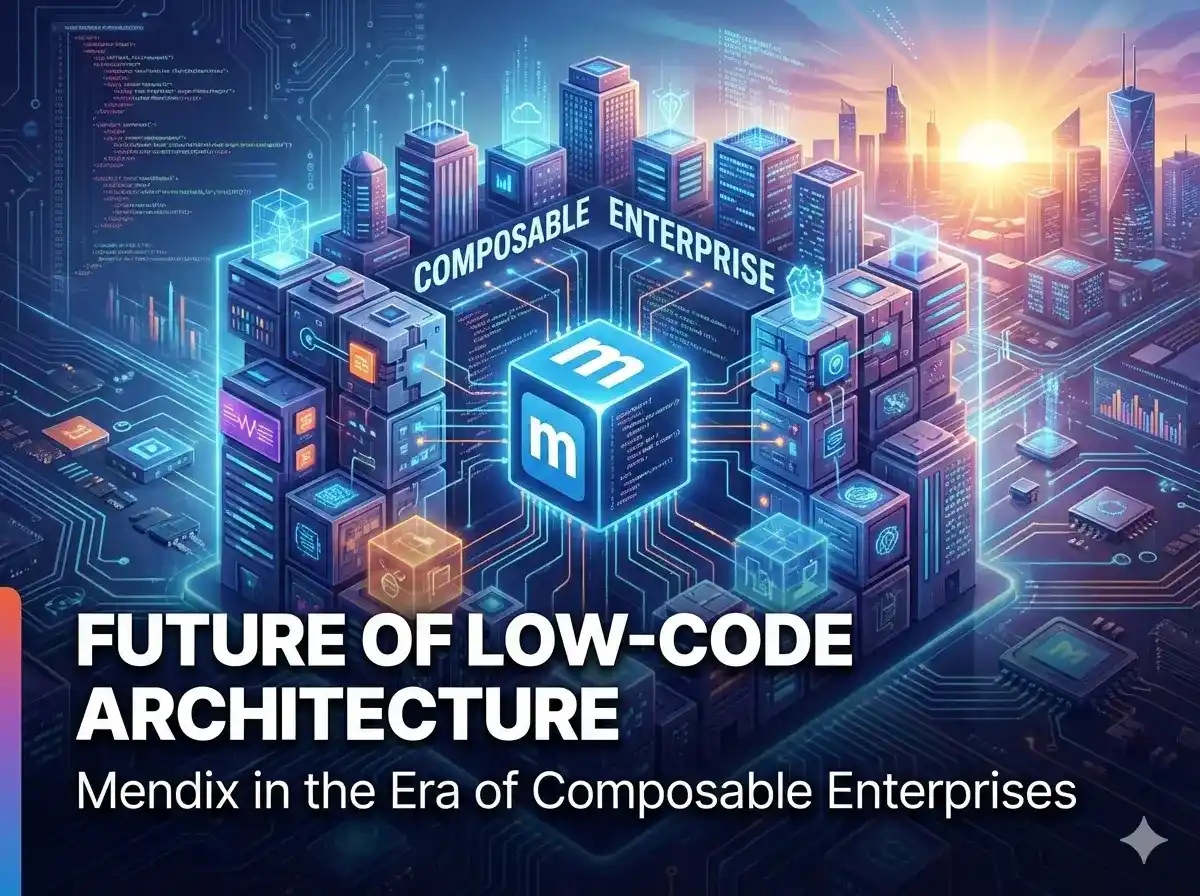
Enterprise software architecture is entering a decisive new phase. Monolithic platforms and rigid system designs are giving way to composable enterprises—organizations built on modular, interchangeable, and independently scalable capabilities. In this new paradigm, speed alone is no longer the differentiator. Adaptability, resilience, and architectural clarity define success.
Low-code platforms have matured significantly in recent years, moving far beyond rapid prototyping tools. Among them, Mendix has emerged as a serious architectural player—one that aligns closely with composable enterprise principles when used with intent and discipline.
This article explores the future of low-code architecture through the lens of composability and examines how Mendix enables modularity, reuse, and agility—without oversimplifying the realities of enterprise systems.
Understanding the Shift Toward Composable Enterprises
Composable enterprises are built on the idea that business capabilities should be assembled rather than hardwired. Instead of relying on large, tightly coupled systems, organizations design their digital landscape as a collection of independent building blocks.
Key characteristics of composable enterprises include:
Modular business capabilities
API-first integration
Decoupled user experiences
Independent deployment and scaling
Rapid recomposition as business needs change
This architectural shift demands tooling that supports change without chaos. Low-code platforms are increasingly evaluated not on how fast they build applications, but on how well they support composability.
Where Low-Code Architecture Is Heading
Early low-code adoption focused on speed—reducing development time and lowering technical barriers. The future, however, is architectural.
Modern low-code platforms are expected to:
Fit into distributed system architectures
Consume and expose APIs cleanly
Support modular application design
Enable reuse across teams
Coexist with traditional codebases
This evolution is particularly relevant for enterprises evaluating the best low code platform for enterprises USA, where governance, scale, and long-term viability matter as much as delivery speed.
Mendix as an Enabler of Composable Architecture
Mendix aligns naturally with composable enterprise principles when applied correctly. Its strength lies not in replacing backend systems, but in orchestrating, extending, and composing them.
At an architectural level, Mendix supports:
API-driven integration patterns
Modular domain modeling
Separation of experience, process, and data layers
Incremental modernization strategies
This positions Mendix as a strong candidate for organizations pursuing structured low-code development Mendix initiatives within broader enterprise ecosystems.
Composable Design Through Modular Applications
In a composable environment, applications are not treated as standalone artifacts. They are assembled from reusable services and shared components.
Mendix supports this approach through:
Modular application architecture
Reusable microflows and domain models
Shared integration layers
Centralized governance with decentralized delivery
These capabilities allow teams to compose solutions quickly without rebuilding core logic repeatedly.
API-Centric Thinking as the Foundation
Composable enterprises are API-driven by necessity. Mendix applications work best when they consume well-defined backend services rather than embedding complex domain logic directly.
This model enables:
Independent evolution of backend systems
Faster UI and workflow changes
Reduced coupling between teams
It also allows Mendix to coexist cleanly with microservices, event-driven systems, and legacy platforms.
Modernizing Legacy Systems Without Full Replacement
One of the most practical applications of composable architecture is incremental modernization. Enterprises rarely have the luxury of full rewrites.
Mendix plays a valuable role in strategies that migrate legacy systems with low code USA teams by:
Wrapping existing systems with modern interfaces
Replacing specific workflows instead of entire platforms
Enabling gradual transition rather than disruptive change
This approach reduces risk while delivering visible business value early.
Composable Low-Code for Different Organization Types
Composable architecture is not exclusive to large enterprises. Its principles apply across organization sizes, though implementation varies.
Startups
For low code development for startups USA, composability means building flexible foundations early—allowing products to evolve without architectural rewrites.
Small Businesses
A low code agency for small business USA often focuses on modular internal solutions that can grow with the organization rather than locking it into rigid systems.
Enterprises
Large organizations benefit from federated composability, where teams build independently within shared architectural standards.
Internal Tooling as a Composable Use Case
Internal tools are ideal candidates for composable low-code architectures. They require speed, adaptability, and integration with existing systems.
Many organizations build internal tools with low code USA teams to:
Automate operational workflows
Improve visibility through dashboards
Adapt processes without core system changes
These tools often sit at the edge of enterprise architecture, making them perfect examples of composable design in practice.
Cost Considerations in the Composable Low-Code Future
As low-code becomes more strategic, cost discussions shift from licensing alone to overall value and sustainability.
Decision-makers increasingly ask how much does low code development cost in USA, factoring in:
Development speed
Maintenance effort
Scalability
Reduced dependency on scarce engineering talent
Composable architectures tend to lower long-term costs by enabling reuse and reducing rework.
The Role of Mendix Consulting in Composable Adoption
Composable architectures require architectural clarity. Tooling alone is insufficient.
This is where Mendix consulting in USA plays a critical role—helping organizations define boundaries, integration patterns, and governance models that support modular growth.
A strong consulting approach focuses on:
Capability mapping
API strategy
Application ownership models
Lifecycle governance
Execution Matters More Than Platform Choice
Organizations often look for the best Mendix development company in the USA, but success depends less on the vendor label and more on execution discipline.
Composable success requires:
Clear architectural intent
Consistent patterns
Shared standards
Ongoing refinement
Without these, even the most capable platforms fall short.
From Services to Solutions
As low-code matures, enterprises increasingly expect partners to deliver outcomes rather than code.
This is where structured Mendix Development Services evolve into a comprehensive Mendix Development Solution – one that aligns architecture, delivery, and governance under a single vision.
Beyond Delivery: Long-Term Enablement
Composable enterprises are built, not delivered once. They require continuous alignment between business and technology.
This is why Mendix consulting Services increasingly focus on:
Enablement rather than dependency
Internal capability building
Architectural stewardship
The role of a Mendix Consultant is shifting from implementer to long-term advisor.
Why Composability Demands Thoughtful Low-Code Use
Low-code platforms can accelerate composability—but only when used intentionally.
Misuse leads to:
Hidden coupling
Shadow integrations
Fragmented ownership
Used correctly, Mendix becomes a powerful orchestration and composition layer rather than a replacement for core systems.
What the Future Holds
The future of low-code architecture is not about replacing developers or simplifying complexity away. It is about managing complexity intelligently.
Composable enterprises will:
Combine low-code and traditional development
Invest in API maturity
Embrace modular thinking
Optimize for adaptability rather than perfection
Mendix is well-positioned for this future—not because it is low-code, but because it supports architectural clarity when applied with discipline.
Conclusion
Composable enterprises represent a fundamental shift in how organizations design, evolve, and scale their digital capabilities. Low-code platforms are becoming architectural tools—not shortcuts.
When used strategically, Mendix enables modularity, reuse, and agility while respecting the realities of enterprise systems. Its true value emerges not in isolation, but as part of a well-governed, API-driven ecosystem.
The future belongs to organizations that understand where low-code fits—and where it doesn’t—and use it as a force multiplier rather than a replacement for sound architecture.
About the author

Ashok Kata
Ashok Kata is the Founder of We LowCode, a top low-code firm in Hampton, VA. With 14+ years in IT, he specializes in Mendix, OutSystems, Angular, and more. A certified Mendix Advanced Developer, he leads a skilled team delivering scalable, intelligent apps that drive rapid, cost-effective digital transformation.
Ashok Kata
Ashok Kata is the Founder of We LowCode, a top low-code firm in Hampton, VA. With 14+ years in IT, he specializes in Mendix, OutSystems, Angular, and more. A certified Mendix Advanced Developer, he leads a skilled team delivering scalable, intelligent apps that drive rapid, cost-effective digital transformation.
- Ashok K
- Ashok K

We help businesses accelerate digital transformation with expert Low-Code development services—delivering secure, scalable, and future-ready solutions.
Contact us
Location
- Hampton, VA 23662 United States of America
Phone
- +1(512)-779-6895
Email us
- contact@welowcode.com