- contact@welowcode.com
- Hampton, VA 23662

Advanced Microflow Optimization Techniques for High-Throughput Mendix Apps
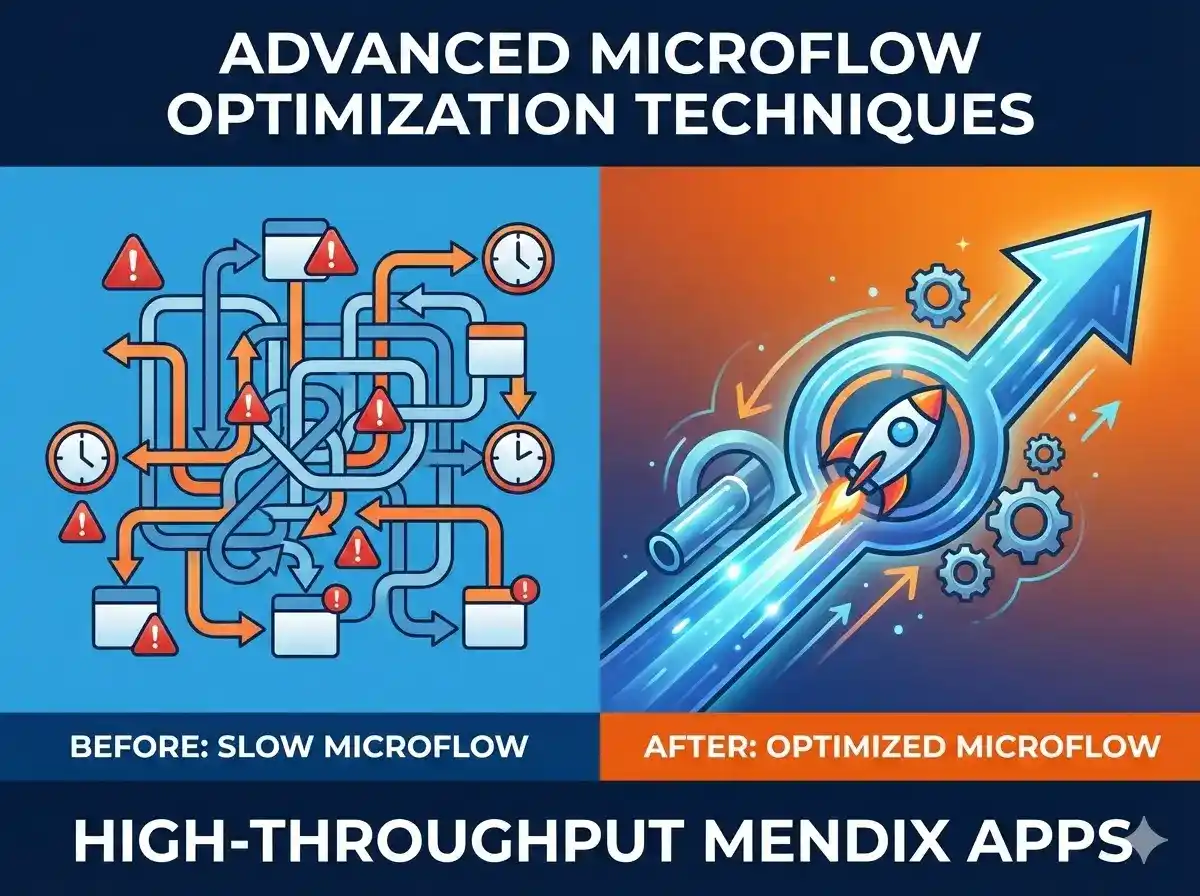
As Mendix applications move from departmental tools to enterprise-grade systems, performance expectations rise sharply. Applications are no longer supporting dozens of users—they are serving hundreds or thousands of concurrent requests, executing complex workflows, and integrating with multiple backend systems.
In these scenarios, microflows become the primary performance bottleneck.
While Mendix abstracts much of the complexity of application development, high-throughput systems still require careful design, disciplined modeling, and performance-aware decision-making. Poorly optimized microflows can introduce unnecessary latency, excessive database load, and transaction contention—ultimately limiting scalability.
This article explores advanced microflow optimization techniques used in real-world, high-throughput Mendix applications. The focus is not on basic best practices, but on deeper architectural and execution-level optimizations that significantly improve transaction performance.
Why Microflow Optimization Matters at Scale
At low traffic volumes, inefficient microflows often go unnoticed. As usage grows, however, even small inefficiencies compound rapidly.
Common symptoms of microflow-related performance issues include:
Slow response times under load
Increased database locks and wait times
High CPU or memory usage
Unpredictable behavior during peak traffic
In high-throughput environments, microflows must be treated as critical execution paths, not just visual representations of logic.
Understanding Microflow Execution Cost
Before optimizing, it’s important to understand what actually consumes time during microflow execution.
Key contributors to microflow latency:
Database retrievals and commits
Object instantiation and association traversal
Loop execution over large datasets
Synchronous integrations
Transaction boundaries
Optimizing microflows is less about making them “shorter” and more about reducing unnecessary work inside a single transaction.
1. Minimize Database Round-Trips
The most common performance issue in Mendix microflows is excessive database interaction.
Avoid Retrievals Inside Loops
Retrieving data inside a loop causes repeated database calls, multiplying latency with every iteration.
Better approach:
Retrieve required data once
Use in-memory lists
Filter using XPath where possible
A single optimized retrieval can replace dozens or hundreds of database calls.
2. Reduce Object Instantiation and Commit Frequency
Each object creation and commit carries overhead—especially in high-concurrency environments.
Optimization Techniques
Create objects only when strictly necessary
Avoid committing intermediate objects
Use “Commit without events” where applicable
Batch commits at logical checkpoints
Excessive commits increase transaction duration and raise the likelihood of database contention.
3. Control Transaction Scope Explicitly
Microflows often run inside implicit transactions that are broader than required.
Why This Matters
Long-running transactions:
Hold database locks longer
Increase rollback cost on failure
Reduce overall throughput
Advanced Technique
Split complex logic into multiple microflows
Use non-transactional subflows for read-only logic
Commit early when consistency allows
Smaller transaction scopes improve concurrency and stability.
4. Optimize Association Traversals
Deep or poorly designed domain models can significantly slow microflow execution.
Common Pitfall
Traversing multiple associations in loops or expressions without constraints.
Optimization Strategy
Flatten data structures where appropriate
Use XPath constraints instead of post-retrieval filtering
Avoid unnecessary reference set traversals
Domain model design directly impacts microflow performance.
5. Replace Synchronous Integrations with Asynchronous Patterns
Synchronous calls to external systems block microflow execution and tie up resources.
High-Throughput Best Practice
Use asynchronous microflows for integrations
Queue integration requests
Process responses separately
This pattern dramatically improves responsiveness and protects core workflows from external latency.
6. Use Microflow Logic Instead of Expressions in Critical Paths
Complex expressions may look concise, but they are often harder to optimize and debug.
Why This Matters
Expressions are evaluated at runtime
Complex logic in expressions reduces readability
Harder to profile and optimize
For performance-critical logic, explicit microflow steps are often clearer and more efficient.
7. Limit the Use of Nested Microflows
While modularization improves maintainability, excessive nesting introduces overhead.
Balanced Approach
Use sub-microflows for reusable logic
Avoid deep call chains in high-frequency execution paths
Inline logic where performance is critical
Optimization often involves trading abstraction for execution efficiency.
8. Optimize Error Handling Without Overhead
Robust error handling is essential—but it should not dominate execution paths.
Best Practices
Avoid heavy logging inside loops
Log only actionable errors
Separate error reporting from business logic
Efficient error handling preserves performance while maintaining observability.
9. Measure, Don’t Guess
Advanced optimization is impossible without measurement.
Key tools and techniques:
Mendix Runtime statistics
Database query analysis
Load testing with realistic data volumes
Profiling microflow execution time
Optimization should be driven by evidence, not assumptions.
10. Design Microflows for Predictable Execution
Predictability matters more than raw speed in enterprise systems.
High-performing microflows:
Have consistent execution paths
Avoid conditional logic explosion
Fail fast when preconditions aren’t met
Predictable execution improves both performance and maintainability.
High-Throughput Microflows in AI-Driven Mendix Apps
As enterprises embed AI capabilities into Mendix applications, microflow performance becomes even more critical.
AI-powered scenarios often involve:
High-frequency inference calls
Data preprocessing workflows
Real-time decision logic
Organizations offering Mendix AI development services must pay special attention to how microflows orchestrate AI components.
Similarly, Mendix AI integration services frequently introduce external dependencies that must be decoupled from core transaction flows.
Optimizing Microflows for AI Workloads
When supporting Mendix AI application development, microflows should:
Isolate AI calls from user-facing transactions
Cache inference results where possible
Use asynchronous processing for model execution
For teams working on Mendix AI platform development, these patterns are essential to achieving both scalability and responsiveness.
This is why many organizations choose to Hire Mendix AI developers with deep performance expertise rather than relying on default modeling patterns.
Microflow Optimization in the Broader Low-Code Landscape
While these techniques are Mendix-specific, the principles apply broadly across low code development platforms.
High-performance low-code applications require:
Architectural discipline
Data-aware modeling
Conscious transaction management
This is where experienced teams within a low-code development company differentiate themselves—by delivering systems that scale predictably under load.
Organizations investing in professional low-code development services increasingly expect this level of performance engineering, not just rapid delivery.
Common Mistakes That Limit Throughput
Even experienced teams fall into recurring traps:
Treating microflows as “free” abstractions
Overusing commits for perceived safety
Embedding integration logic directly in UI flows
Ignoring transaction scope
Avoiding these mistakes often yields immediate performance gains.
Performance Is an Architectural Outcome
Microflow optimization is not a one-time task. It reflects broader architectural choices:
Domain model design
Integration patterns
Governance standards
Team maturity
High-throughput Mendix apps succeed because performance is designed in, not patched later.
Conclusion
Advanced microflow optimization is essential for building high-throughput Mendix applications that perform reliably under real-world load. As applications scale, small inefficiencies multiply, turning visual logic into execution bottlenecks.
By minimizing database interactions, controlling transaction scope, optimizing domain models, and decoupling integrations, teams can dramatically reduce microflow latency and improve transaction performance.
Whether supporting AI-driven workflows, enterprise integrations, or large user bases, optimized microflows form the backbone of scalable Mendix systems.
The most successful teams treat microflows not as diagrams—but as critical execution pipelines deserving the same rigor as any high-performance software system.
About the author

Ashok Kata
Ashok Kata is the Founder of We LowCode, a top low-code firm in Hampton, VA. With 14+ years in IT, he specializes in Mendix, OutSystems, Angular, and more. A certified Mendix Advanced Developer, he leads a skilled team delivering scalable, intelligent apps that drive rapid, cost-effective digital transformation.
Ashok Kata
Ashok Kata is the Founder of We LowCode, a top low-code firm in Hampton, VA. With 14+ years in IT, he specializes in Mendix, OutSystems, Angular, and more. A certified Mendix Advanced Developer, he leads a skilled team delivering scalable, intelligent apps that drive rapid, cost-effective digital transformation.
- Ashok K
- Ashok K

We help businesses accelerate digital transformation with expert Low-Code development services—delivering secure, scalable, and future-ready solutions.
Contact us
Location
- Hampton, VA 23662 United States of America
Phone
- +1(512)-779-6895
Email us
- contact@welowcode.com