- contact@welowcode.com
- Hampton, VA 23662

How Enterprises Use Low-Code to Reduce Time-to-Market by 60%
Speed has become one of the most decisive competitive advantages in enterprise software development. Whether launching a new digital product, responding to regulatory change, or improving internal operations, organizations that move faster consistently outperform those that don’t.
Yet, for many enterprises, traditional development models struggle to keep pace. Long release cycles, overloaded engineering teams, and tightly coupled systems often turn even small changes into multi-month initiatives. This gap between business urgency and delivery capability is exactly where low-code platforms are making a measurable impact.
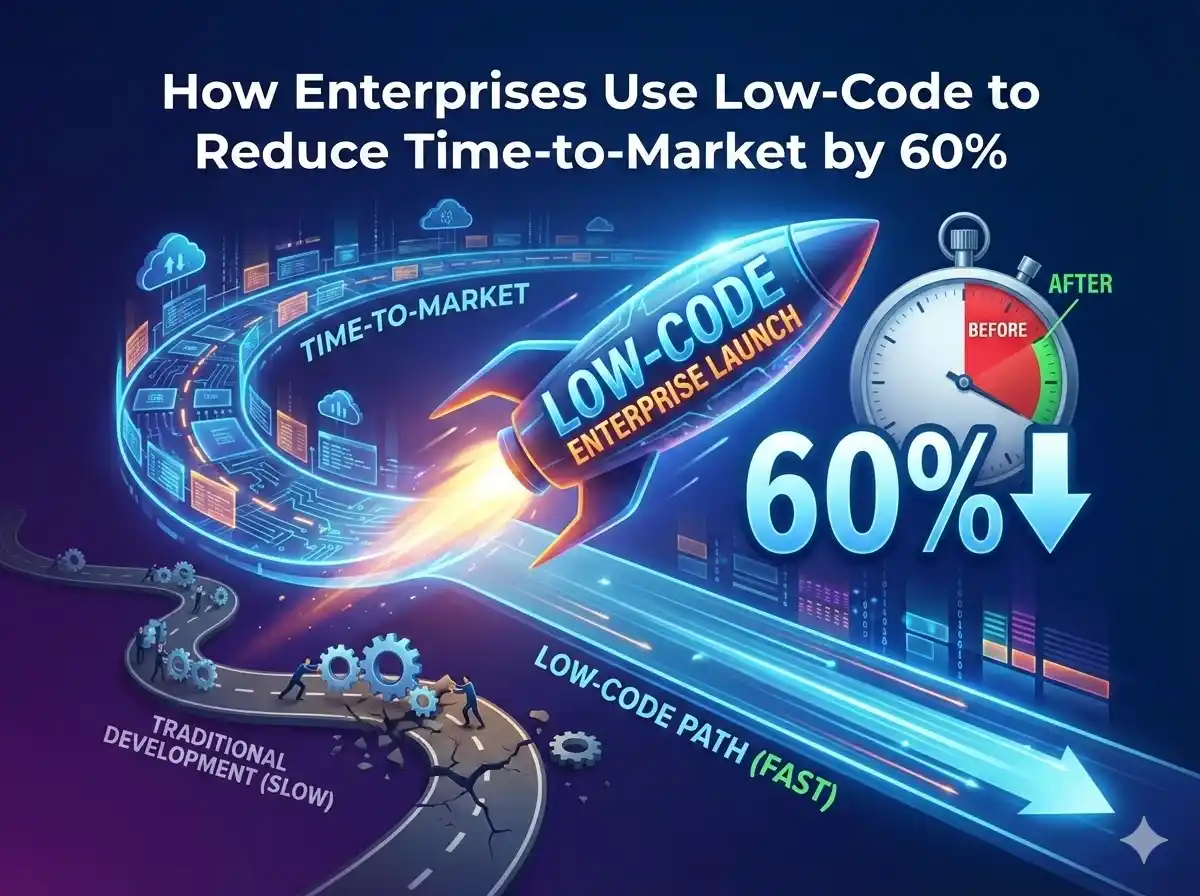
Across industries, enterprises are using low-code to reduce time-to-market by as much as 60%—not by cutting corners, but by changing how software is designed, built, and evolved.
This article explores how enterprises achieve that acceleration, where low-code delivers the most value, and why the results are sustainable rather than short-lived.
Why Time-to-Market Is an Enterprise Problem—Not Just a Development One
Time-to-market is often framed as a technical challenge, but in reality, it’s an organizational one.
Enterprises face structural constraints such as:
Multiple approval layers
Legacy systems that are hard to change
Fragmented ownership across teams
Long feedback loops between business and IT
Traditional development amplifies these issues because it requires high coordination, deep technical dependency, and long testing cycles. As a result, even well-funded teams struggle to deliver quickly.
Low-code changes this dynamic by reducing dependency friction, not by eliminating rigor.
What “60% Faster” Actually Means in Practice
Reducing time-to-market by 60% does not mean developers work faster hours or skip quality checks. It means:
Fewer handoffs
Less rework
Faster feedback cycles
Earlier validation of assumptions
Enterprises consistently report that low-code shortens delivery timelines by:
Accelerating initial development
Simplifying iteration
Reducing integration overhead
The gains compound over time, especially in environments where change is constant.
How Low-Code Removes Bottlenecks in Enterprise Delivery
The biggest delays in enterprise software rarely occur in coding alone. They occur in coordination, alignment, and change management.
Low-code platforms help by:
Enabling visual, model-driven development
Making application logic easier to understand across roles
Allowing business stakeholders to validate functionality earlier
This shared visibility reduces misunderstandings and late-stage changes, which are among the most expensive sources of delay.
Using Low-Code Where It Has the Highest Impact
Enterprises that achieve the greatest time-to-market gains are selective about where they apply low-code.
The most effective use cases include:
Workflow automation
Customer and partner portals
Internal operational tools
Orchestration layers over existing systems
These areas typically require frequent updates but do not justify the overhead of full-scale traditional development for every change.
Parallel Development Without Chaos
One of the most powerful ways enterprises reduce delivery time is by enabling parallel work streams.
Low-code allows teams to:
Build user interfaces while backend services are still evolving
Prototype workflows before final integrations are complete
Isolate changes to specific modules
This parallelism dramatically shortens overall delivery timelines without increasing risk.
Faster Iteration Through Early Feedback
Traditional development often delays feedback until late in the cycle—after code is written, integrated, and tested. By then, changes are costly.
Low-code enables:
Rapid prototyping
Early stakeholder validation
Incremental refinement
Enterprises that embrace this approach avoid building the wrong solution fast—and instead build the right solution sooner.
Why Governance Doesn’t Have to Slow You Down
A common misconception is that governance and speed are opposing forces. In reality, well-designed governance accelerates delivery.
Low-code platforms support:
Standardized patterns
Reusable components
Controlled deployment pipelines
This consistency reduces the need to reinvent solutions, which in turn speeds up development across teams.
The Role of Expertise in Accelerating Results
Low-code does not eliminate the need for experience. In fact, expertise becomes even more valuable when speed matters.
An experienced mendix consultant helps enterprises:
Identify high-impact use cases
Define architectural boundaries
Avoid performance and scalability pitfalls
This guidance ensures that speed gains are sustainable and do not lead to technical debt.
Low-Code and Legacy Systems: Speed Without Disruption
Legacy systems are one of the biggest barriers to rapid delivery. Replacing them entirely is risky and slow.
Enterprises reduce time-to-market by using low-code to:
Build modern interfaces over legacy platforms
Automate processes without changing core logic
Introduce new capabilities incrementally
This approach delivers visible improvements quickly while minimizing operational risk.
Organizational Alignment: Business and IT Working Together
Time-to-market improves dramatically when business and IT are aligned around shared outcomes.
Low-code fosters this alignment by:
Making logic more accessible
Enabling collaborative design sessions
Reducing translation gaps between requirements and implementation
When teams collaborate earlier and more often, delays shrink naturally.
Scaling Speed Across the Organization
The true value of low-code emerges when speed is not limited to one team or project.
Enterprises scale time-to-market improvements by:
Establishing shared low-code standards
Creating centers of excellence
Promoting reuse across applications
Over time, delivery velocity becomes an organizational capability rather than a one-time win.
Why Platform Choice Still Matters
Not all low-code platforms deliver the same results at enterprise scale. Stability, integration flexibility, and governance capabilities vary widely.
This is why many organizations work with a specialized low-code development company to evaluate platforms, design delivery models, and ensure long-term success.
The right foundation amplifies speed gains rather than constraining them.
Measuring Time-to-Market Improvements
Enterprises that successfully reduce delivery timelines track more than just release dates.
They measure:
Cycle time from idea to deployment
Frequency of releases
Change failure rates
Time spent on rework
Low-code consistently improves these metrics by simplifying the path from concept to production.
Common Mistakes That Limit Speed Gains
Despite its potential, low-code can fail to deliver time-to-market improvements when misused.
Common mistakes include:
Applying low-code to inappropriate core systems
Ignoring governance
Treating low-code as a shortcut rather than a strategy
Scaling too fast without standards
Avoiding these pitfalls is essential for sustained acceleration.
Why the 60% Reduction Is Sustainable
The most important aspect of enterprise low-code adoption is that time-to-market improvements are not temporary.
They persist because:
Reusable assets accumulate
Teams become more autonomous
Change becomes less disruptive
Over time, the organization builds momentum rather than starting from scratch with each initiative.
Conclusion
Reducing time-to-market by 60% is not the result of working faster—it’s the result of working differently.
Enterprises achieve this acceleration by using low-code where it creates the most leverage: in workflows, integrations, and user-facing layers that change frequently. By reducing friction between business and IT, enabling parallel development, and supporting incremental modernization, low-code transforms delivery speed into a strategic advantage.
When applied with discipline and guided by experience, low-code becomes more than a productivity tool. It becomes a core enabler of enterprise agility—allowing organizations to respond to change not in months, but in weeks.
About the author

Ashok Kata
Ashok Kata is the Founder of We LowCode, a top low-code firm in Hampton, VA. With 14+ years in IT, he specializes in Mendix, OutSystems, Angular, and more. A certified Mendix Advanced Developer, he leads a skilled team delivering scalable, intelligent apps that drive rapid, cost-effective digital transformation.
Ashok Kata
Ashok Kata is the Founder of We LowCode, a top low-code firm in Hampton, VA. With 14+ years in IT, he specializes in Mendix, OutSystems, Angular, and more. A certified Mendix Advanced Developer, he leads a skilled team delivering scalable, intelligent apps that drive rapid, cost-effective digital transformation.
- Ashok K
- Ashok K

We help businesses accelerate digital transformation with expert Low-Code development services—delivering secure, scalable, and future-ready solutions.
Contact us
Location
- Hampton, VA 23662 United States of America
Phone
- +1(512)-779-6895
Email us
- contact@welowcode.com