- contact@welowcode.com
- Hampton, VA 23662

Low-Code Testing Strategies in Mendix: Automated UI, Integration, and Regression Tests
As Mendix applications move from departmental tools to enterprise-critical systems, expectations around quality, reliability, and release velocity rise sharply. Low-code accelerates development—but without a solid testing strategy, speed can quickly turn into risk.
In enterprise environments, testing is no longer a final checkpoint before deployment. It is an ongoing discipline that ensures applications remain stable as features evolve, integrations expand, and usage scales. This is especially true for Mendix, where rapid iteration and frequent releases are part of the platform’s core value.
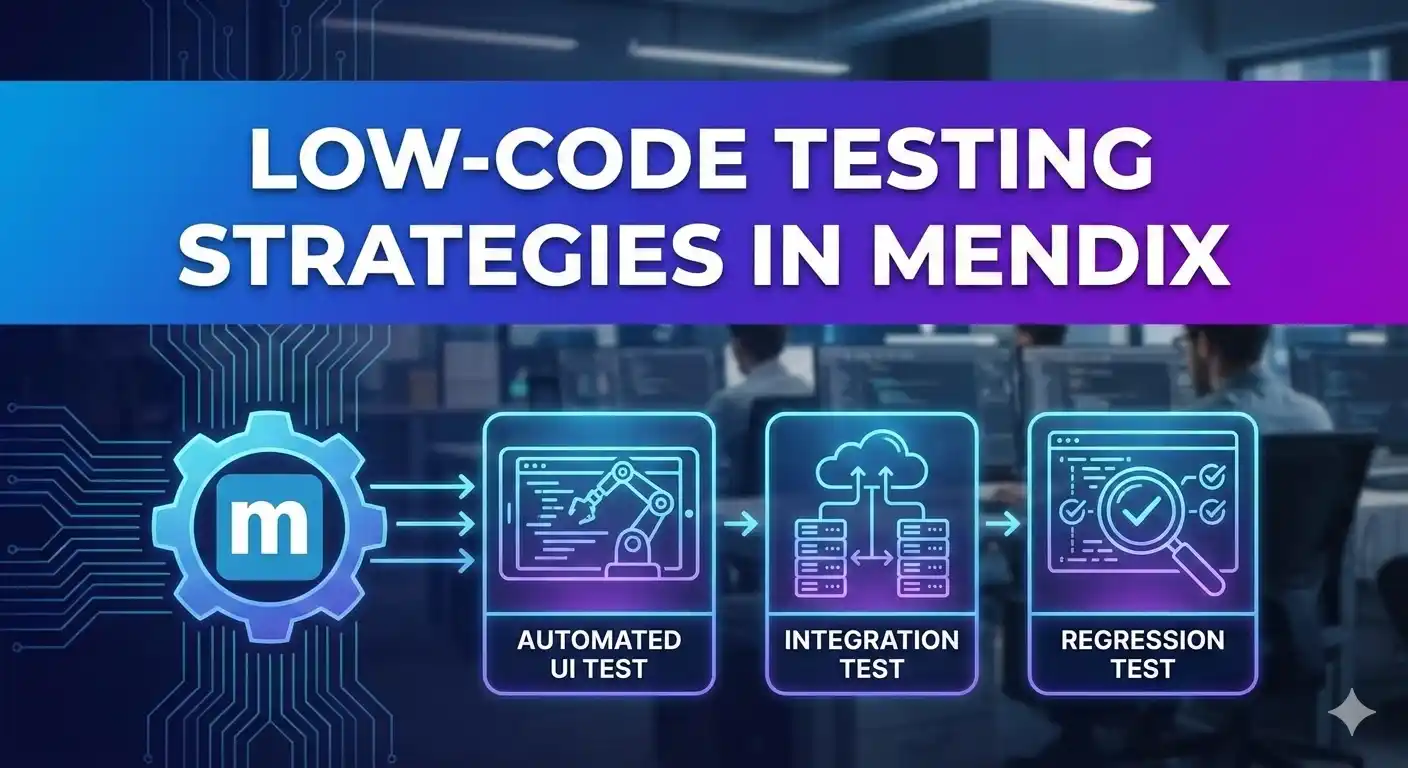
This article explores enterprise-grade testing strategies for Mendix applications, focusing on automated UI testing, integration testing, and regression testing using tools such as Selenium, Menditect, and ATS. The goal is not to test more, but to test smarter—without slowing delivery.
Why Testing Requires a Different Approach in Low-Code
Traditional testing strategies were designed around hand-coded applications with long release cycles. Low-code changes this dynamic.
In Mendix environments:
Features are delivered faster
Releases are more frequent
Changes often affect multiple workflows
Visual models evolve continuously
Manual testing alone cannot keep up with this pace. Enterprise teams must adopt automation strategically to maintain quality without becoming a bottleneck.
Understanding the Mendix Testing Landscape
Testing in Mendix spans multiple layers:
User interface behavior
Business logic and microflows
External system integrations
End-to-end process validation
Each layer requires different tools and techniques. A single testing approach rarely covers everything effectively.
Successful teams design layered testing strategies, where each tool is used for what it does best.
Automated UI Testing with Selenium
UI testing is often the most visible—and the most fragile—part of enterprise testing.
Why Selenium Is Still Relevant
Selenium remains a popular choice for UI automation because:
It supports real browsers
It aligns well with user-centric testing
It integrates with existing CI/CD pipelines
In Mendix, Selenium is best used for critical user journeys, not exhaustive UI coverage.
Best Practices for Selenium in Mendix
Test workflows, not individual UI elements
Avoid brittle selectors tied to layout changes
Focus on high-value paths such as onboarding, approvals, and submissions
Keep UI tests minimal and stable
Overusing Selenium can slow pipelines and increase maintenance effort.
Integration Testing: Where Enterprise Risk Lives
In most Mendix applications, failures occur not in isolated logic—but at integration points.
These include:
REST and SOAP services
Identity and access systems
ERP and CRM platforms
External data providers
Integration testing validates that Mendix applications behave correctly when interacting with external systems.
Using ATS for Integration Testing
ATS (Automated Test Suite) is particularly effective for testing Mendix integrations and microflow logic.
Where ATS Fits Best
Validating microflow execution paths
Testing service responses and error handling
Verifying data consistency
Supporting regression testing at the logic level
Because ATS operates closer to the application logic, it is less sensitive to UI changes and offers higher stability.
Regression Testing as a Core Discipline
Regression testing is essential in low-code environments, where frequent changes are expected.
Without automation:
Teams retest the same scenarios repeatedly
Release cycles slow down
Defects slip into production
Automated regression testing ensures that new features do not break existing functionality.
Menditect: Model-Based Testing for Mendix
Menditect offers a model-driven approach to testing that aligns naturally with Mendix’s visual development paradigm.
Why Menditect Is Valuable
Tests are derived from application models
Coverage evolves as the application evolves
Reduced dependency on UI selectors
Strong alignment with business logic
For enterprise teams, Menditect provides a scalable way to maintain regression coverage without excessive manual effort.
Combining Tools for Full Coverage
No single tool provides complete coverage. Enterprise-grade testing strategies combine multiple tools intentionally.
A common pattern looks like this:
Selenium for critical UI flows
ATS for microflow and integration validation
Menditect for broad regression coverage
This layered approach balances speed, reliability, and maintenance cost.
Designing Testable Mendix Applications
Testing effectiveness depends heavily on how applications are designed.
Testable Mendix applications:
Have clear separation between UI and logic
Use consistent naming conventions
Avoid hardcoded dependencies
Expose logic through reusable microflows
Designing for testability reduces long-term testing effort and improves overall quality.
Embedding Testing into CI/CD Pipelines
Automation delivers the most value when integrated into delivery pipelines.
Enterprise Mendix teams embed testing into:
Build pipelines
Deployment workflows
Release gates
This ensures defects are detected early—before they reach users.
Balancing Speed and Confidence
One of the biggest misconceptions is that testing slows down low-code delivery. In reality, poor testing slows teams down far more.
Automated testing:
Reduces manual verification
Builds confidence in frequent releases
Enables faster iteration
A seasoned Mendix Expert understands that testing is what makes speed sustainable—not risky.
Governance and Ownership of Test Automation
As test automation grows, governance becomes essential.
Enterprises should define:
Test ownership models
Standards for test creation
Criteria for pipeline failures
Maintenance responsibilities
Without governance, automation becomes fragmented and unreliable.
The Role of External Expertise
Many organizations accelerate testing maturity by working with specialized partners.
A low code agency USA often brings:
Proven testing frameworks
Experience across enterprise projects
Best practices for scaling automation
This external perspective helps teams avoid trial-and-error approaches that slow progress.
Common Testing Mistakes to Avoid
Even experienced teams make recurring mistakes:
Automating too much UI too early
Ignoring integration failures
Treating test automation as a one-time effort
Allowing tests to become outdated
Avoiding these pitfalls requires continuous attention and refinement.
Measuring Testing Effectiveness
Effective testing strategies are measurable.
Enterprises track:
Defect leakage rates
Test execution time
Pipeline stability
Release confidence
These metrics help teams improve quality without sacrificing velocity.
Testing as an Enabler of Enterprise Low-Code
In enterprise environments, low-code success depends on trust. Stakeholders must trust that applications will behave predictably as they evolve.
Robust testing:
Builds confidence in frequent releases
Protects business-critical workflows
Enables continuous improvement
Testing is not a constraint—it is an enabler.
Conclusion
Low-code platforms like Mendix accelerate development, but they do not eliminate the need for rigorous testing. On the contrary, frequent releases and rapid iteration make automated testing more important than ever.
By combining UI automation with Selenium, logic and integration testing with ATS, and model-based regression testing with Menditect, enterprises can build resilient testing strategies that scale alongside their applications.
The most successful Mendix teams treat testing as a continuous discipline—embedded into design, development, and delivery. When done right, testing doesn’t slow low-code down. It ensures that speed remains an advantage rather than a liability.
About the author

Ashok Kata
Ashok Kata is the Founder of We LowCode, a top low-code firm in Hampton, VA. With 14+ years in IT, he specializes in Mendix, OutSystems, Angular, and more. A certified Mendix Advanced Developer, he leads a skilled team delivering scalable, intelligent apps that drive rapid, cost-effective digital transformation.
Ashok Kata
Ashok Kata is the Founder of We LowCode, a top low-code firm in Hampton, VA. With 14+ years in IT, he specializes in Mendix, OutSystems, Angular, and more. A certified Mendix Advanced Developer, he leads a skilled team delivering scalable, intelligent apps that drive rapid, cost-effective digital transformation.
- Ashok K
- Ashok K

We help businesses accelerate digital transformation with expert Low-Code development services—delivering secure, scalable, and future-ready solutions.
Contact us
Location
- Hampton, VA 23662 United States of America
Phone
- +1(512)-779-6895
Email us
- contact@welowcode.com