- contact@welowcode.com
- Hampton, VA 23662

AI and Automation in Mendix: How to Enhance Your Low-Code Apps with AI Models
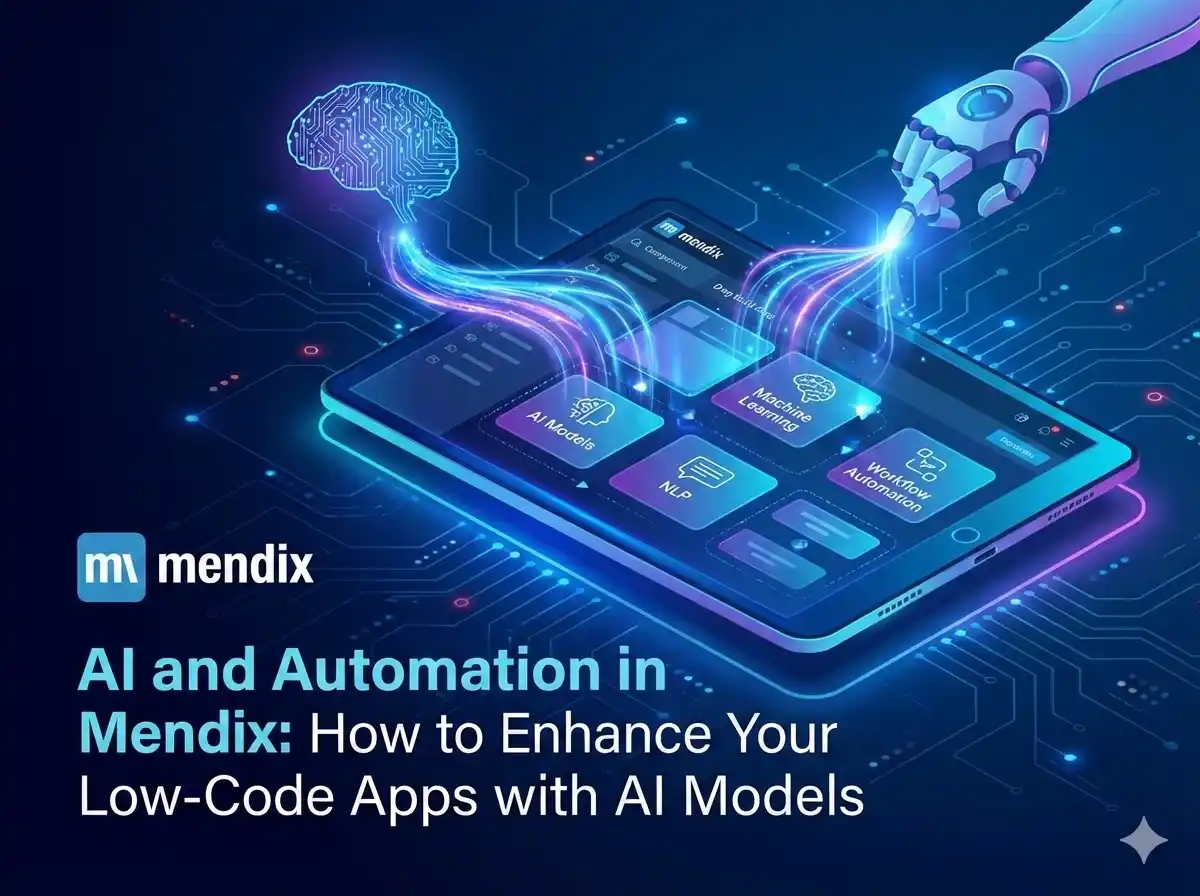
Low-code adoption inside enterprises has reached a point where speed alone is no longer enough. Most organizations can already build applications faster with Mendix. The real differentiator now lies in how intelligent those applications are once they’re live.
Enterprises are increasingly asking deeper questions:
Can applications adapt to changing data patterns?
Can workflows make informed decisions instead of following static rules?
Can automation reduce human effort without increasing operational risk?
AI and automation in Mendix address these questions—but not in the way many teams initially expect. This is not about sprinkling AI features into apps. It’s about designing low-code applications that incorporate intelligence as a first-class architectural concern.
Why AI in Low-Code Is an Architectural Decision, Not a Feature
In enterprise environments, AI rarely fails because of model quality. It fails because of where and how it’s embedded.
Teams that approach AI in Mendix as a feature often:
Hardcode AI calls into microflows
Tie business logic directly to model outputs
Ignore lifecycle management and observability
At scale, this creates fragile systems that are difficult to maintain, govern, and evolve.
High-performing Mendix architectures treat AI as:
A service, not embedded logic
An advisory input, not a decision dictator
A component with its own lifecycle, monitoring, and fallback behavior
This mindset shift is what separates experimentation from enterprise readiness.
Where AI Actually Adds Value in Mendix Applications
Not every Mendix application benefits from AI. In fact, forcing AI into deterministic workflows often adds cost without value.
Enterprise use cases where AI consistently delivers impact include:
Intelligent routing and prioritization
Prediction-based decision support
Pattern recognition across large datasets
Automated classification and tagging
Anomaly detection in operational workflows
In these scenarios, AI complements Mendix’s strength in orchestration rather than replacing business logic.
Automation + AI: A Multiplier, Not a Replacement
Automation without intelligence is efficient—but rigid.
AI without automation is insightful—but slow.
Mendix enables the combination of both.
When automation and AI are designed together:
AI evaluates context and uncertainty
Mendix orchestrates execution and governance
Humans remain in the loop where judgment is required
This hybrid model scales far better than fully autonomous designs in enterprise environments.
Designing AI-Ready Mendix Architectures
AI-enabled Mendix applications require different architectural thinking than traditional low-code apps.
Key principles include:
Loose coupling between AI services and core workflows
Clear contracts for model inputs and outputs
Fallback logic when AI confidence is low or services are unavailable
Explainability hooks for audit and governance
Treating AI as an externalized capability ensures that applications remain stable even as models evolve.
Managing Data as a Strategic Asset
AI is only as effective as the data it consumes. In enterprise Mendix environments, data quality and access patterns often matter more than model sophistication.
High-maturity teams:
Curate data explicitly for AI consumption
Avoid overloading transactional flows with heavy preprocessing
Separate operational data from analytical pipelines
Track data drift and relevance over time
This separation prevents AI workloads from degrading core application performance.
Model Lifecycle Management in Low-Code Environments
One of the most overlooked challenges in AI-enabled Mendix apps is lifecycle management.
Models change. Assumptions expire. Performance degrades.
Enterprise-ready implementations plan for:
Versioning of models
Gradual rollout of model updates
Monitoring inference accuracy
Retiring outdated models safely
Without this discipline, AI becomes a hidden source of risk rather than value.
Governance and Compliance Cannot Be Optional
AI introduces new governance requirements—especially in regulated industries.
Mendix applications that embed AI responsibly:
Log model decisions and confidence levels
Preserve audit trails for automated actions
Apply role-based access to AI-driven functionality
Support human override in critical decisions
Governance is not a constraint on innovation; it’s what allows AI adoption to scale safely.
Performance Implications of AI in Mendix
AI workloads often introduce latency, unpredictability, and external dependencies.
Enterprise Mendix architectures mitigate this by:
Avoiding synchronous AI calls in user-facing paths
Using asynchronous processing for heavy inference
Caching results where appropriate
Designing user experiences that tolerate eventual consistency
These patterns protect application responsiveness while still leveraging intelligence.
The Human Factor: Why Expertise Still Matters
Low-code does not eliminate the need for expertise—it changes where expertise is applied.
AI-enabled Mendix applications benefit significantly when organizations Hire Mendix AI developers who understand:
Both Mendix internals and AI integration patterns
Enterprise architecture constraints
Governance, security, and scalability trade-offs
This expertise ensures that AI enhances low-code delivery rather than undermining its strengths.
Common Mistakes Enterprises Make with AI in Mendix
Across large programs, the same mistakes appear repeatedly:
Treating AI as a shortcut to automation
Embedding model logic directly into microflows
Ignoring model monitoring and drift
Assuming AI decisions are always correct
These issues rarely surface immediately—but they compound over time.
From Experimentation to Enterprise Capability
The most successful organizations move through clear phases:
Experimentation – Small pilots and proofs of concept
Standardization – Shared patterns and integration approaches
Governance – Clear rules for AI usage and ownership
Scaling – AI becomes part of the platform, not the project
Mendix supports this progression when AI is treated as a strategic capability rather than an isolated enhancement.
Why Mendix Is Well-Suited for AI-Augmented Applications
Mendix’s strengths align naturally with AI-enabled enterprise systems:
Strong orchestration capabilities
Clear separation between UI, logic, and services
Flexible integration options
Built-in governance mechanisms
When combined with disciplined architectural practices, Mendix becomes an effective execution layer for intelligent automation.
The Future of Low-Code Is Intelligence-Aware
The next generation of enterprise applications will not be defined by how fast they are built—but by how intelligently they operate.
In this future:
AI informs decisions, not dictates them
Automation accelerates execution, not replaces accountability
Low-code platforms act as orchestrators of intelligence
Organizations that embrace this mindset will extract far more value from their Mendix investments than those chasing features alone.
Conclusion
AI and automation in Mendix represent a shift from speed-driven development to intelligence-driven execution. When designed thoughtfully, AI-enhanced low-code applications become more adaptive, resilient, and aligned with real-world complexity.
The key is not adopting AI for its own sake, but embedding it as a governed, observable, and evolvable capability within enterprise architecture. Mendix provides the foundation—but outcomes depend on how intentionally that foundation is used.
Enterprises that approach AI in Mendix with architectural discipline today will be the ones best positioned to scale intelligent automation tomorrow.
About the author

Ashok Kata
Ashok Kata is the Founder of We LowCode, a top low-code firm in Hampton, VA. With 14+ years in IT, he specializes in Mendix, OutSystems, Angular, and more. A certified Mendix Advanced Developer, he leads a skilled team delivering scalable, intelligent apps that drive rapid, cost-effective digital transformation.
Ashok Kata
Ashok Kata is the Founder of We LowCode, a top low-code firm in Hampton, VA. With 14+ years in IT, he specializes in Mendix, OutSystems, Angular, and more. A certified Mendix Advanced Developer, he leads a skilled team delivering scalable, intelligent apps that drive rapid, cost-effective digital transformation.
- Ashok K
- Ashok K

We help businesses accelerate digital transformation with expert Low-Code development services—delivering secure, scalable, and future-ready solutions.
Contact us
Location
- Hampton, VA 23662 United States of America
Phone
- +1(512)-779-6895
Email us
- contact@welowcode.com