- contact@welowcode.com
- Hampton, VA 23662

Containerizing Mendix Apps: Kubernetes Deployments for Large Enterprises
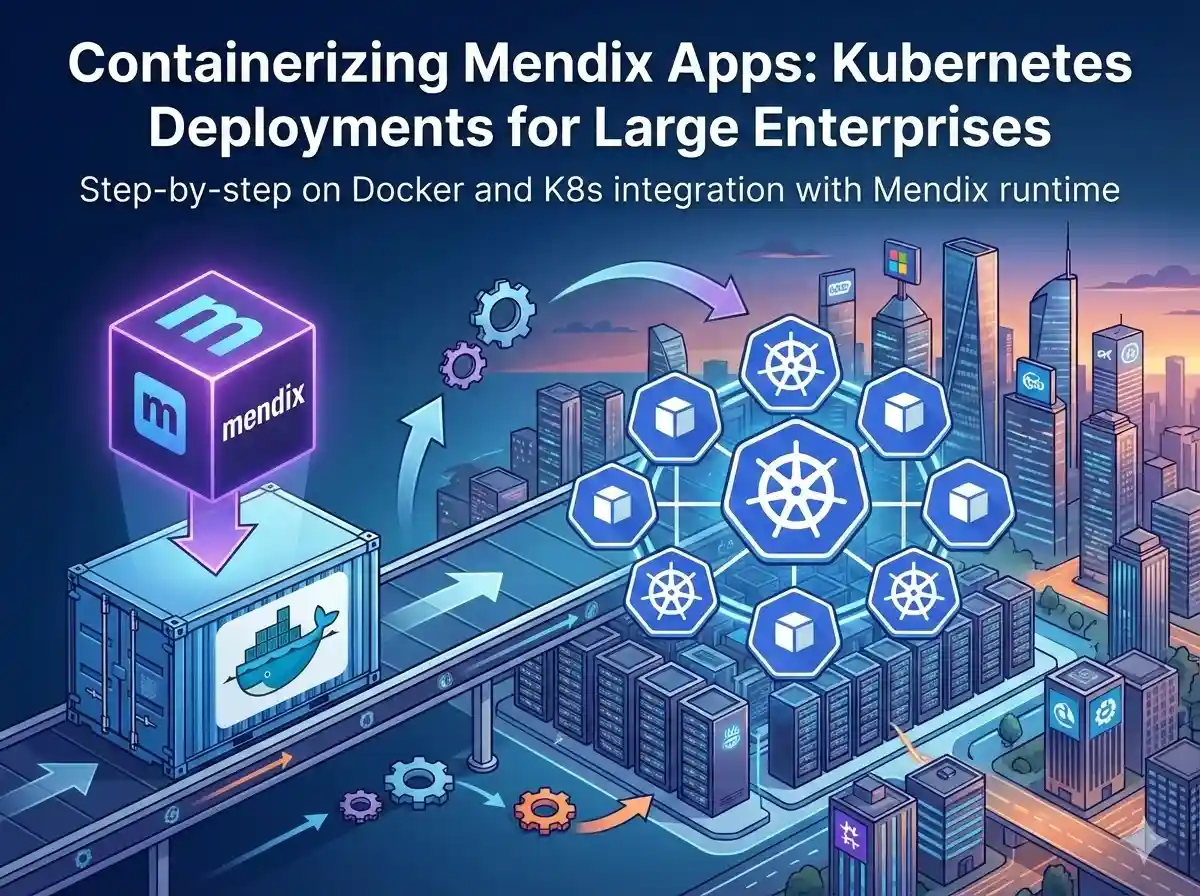
Containerization is no longer an optimization choice for enterprises running Mendix at scale. It is increasingly becoming the default deployment architecture for organizations that require elasticity, isolation, and infrastructure consistency across environments.
However, containerizing Mendix applications is not just about wrapping the runtime in Docker and pushing it to Kubernetes. At enterprise scale, containerization reshapes how applications scale, how failures are handled, how environments are promoted, and how operational maturity is measured.
This guide explores how large enterprises approach Docker and Kubernetes integration with the Mendix runtime — from architectural decisions to deployment pipelines — without reducing the conversation to generic DevOps checklists.
Why Containerization Matters for Enterprise Mendix
Enterprises containerize Mendix applications for four primary reasons:
Environment consistency across development, staging, and production
Infrastructure portability across cloud providers
Horizontal scalability under unpredictable workloads
Improved isolation and operational control
At scale, containerization is less about modern tooling and more about enforcing architectural discipline.
Without containerization, runtime behavior often becomes environment-dependent. With containers, runtime becomes predictable — assuming it is configured correctly.
Understanding Mendix Runtime in a Container Context
Before designing Kubernetes architecture, it is critical to understand how Mendix runtime behaves inside containers.
Key characteristics include:
Stateless application runtime
Externalized database dependency
Environment-driven configuration
Memory-sensitive behavior under load
Mendix applications are naturally suited to containerization because runtime state is not persisted locally. However, performance tuning must account for container resource limits, not just application-level settings.
Step 1: Designing the Docker Image
Containerization begins with building a production-ready Docker image.
Enterprise-grade Docker strategy should include:
Minimal base image selection
Explicit Java memory configuration
Health-check endpoints for liveness and readiness
Separation of build-time and runtime layers
Secure handling of secrets via environment variables
The goal is not simply to containerize the application but to create a portable runtime artifact that behaves consistently across environments.
Overly large images slow deployment cycles. Overly minimal images create observability blind spots. Balance is key.
Step 2: Externalizing Configuration
In Kubernetes environments, configuration must never be hardcoded.
Instead, enterprises externalize:
Database connection parameters
Logging levels
Service endpoints
Authentication configuration
Environment-specific variables
Using ConfigMaps and Secrets ensures environment-specific behavior without modifying the application image.
This separation is critical for scalable multi-environment deployment.
Step 3: Kubernetes Deployment Architecture
Once Docker images are prepared, Kubernetes becomes the orchestration layer.
Enterprise Mendix deployments typically define:
Deployment resources for runtime pods
Service definitions for internal routing
Ingress configuration for external access
Horizontal Pod Autoscalers (HPA)
Resource requests and limits
Resource allocation must reflect actual workload patterns. Over-provisioning increases costs; under-provisioning creates unpredictable performance degradation.
Horizontal scaling is effective only when database and integration layers are equally prepared to handle load.
Step 4: Database and Persistence Strategy
While Mendix runtime is stateless, performance depends heavily on database design.
When deploying on Kubernetes, enterprises must consider:
Managed database services (RDS, Azure SQL, etc.)
Connection pooling limits
Replica strategies for read-heavy workloads
Backup and failover configuration
Container orchestration solves runtime elasticity — not database bottlenecks.
Neglecting database scaling often undermines otherwise well-designed Kubernetes deployments.
Step 5: Observability and Monitoring
Containerized environments increase complexity. Without strong observability, diagnosing issues becomes difficult.
Enterprise-ready deployments integrate:
Centralized logging systems
Metrics collection (CPU, memory, latency)
Pod health monitoring
Distributed tracing for integration-heavy systems
Kubernetes events should complement application-level logging. Observability must operate across both layers.
Many enterprises choose to hire mendix consultant resources during this phase to align runtime observability with architectural expectations rather than relying solely on infrastructure teams.
Step 6: CI/CD Pipeline Integration
Containerization enables consistent deployment — but only when paired with structured pipelines.
A mature Mendix CI/CD pipeline typically includes:
Automated build of Docker images
Static code validation
Environment-specific configuration injection
Automated rollout to staging
Blue/green or rolling deployment strategies
This reduces deployment risk and increases release frequency without compromising stability.
Performance Implications of Kubernetes Deployments
Kubernetes introduces both performance benefits and new variables.
Advantages include:
Elastic scaling under load
Improved fault tolerance
Rapid recovery from node failure
However, risks include:
Cold start latency
Resource throttling due to misconfigured limits
Network overhead between services
Pod churn under unstable autoscaling rules
Performance optimization in Kubernetes is a joint responsibility between DevOps and application architecture.
Cost Implications at Enterprise Scale
Containerized Mendix deployments offer elasticity — but elasticity has cost dynamics.
Enterprises must model:
Node sizing strategy
Autoscaling thresholds
Idle resource consumption
Monitoring and logging storage costs
A Kubernetes cluster that scales aggressively can create unpredictable billing patterns if not governed carefully.
Structured engagement with a low-code development company often accelerates cost modeling maturity, ensuring containerization delivers both performance and financial predictability.
Security in Containerized Mendix Environments
Security posture expands in Kubernetes deployments.
Enterprises must manage:
Container image vulnerability scanning
Role-Based Access Control (RBAC) policies
Network policies for service isolation
Secure secret management
Patch management for base images
Container security is not static. It requires continuous evaluation.
Multi-Cluster and Multi-Region Strategies
Large enterprises often operate across regions.
Kubernetes supports:
Multi-cluster strategies for isolation
Multi-region deployment for latency reduction
Failover clusters for resilience
Designing for portability ensures that containerized Mendix applications can evolve with enterprise infrastructure strategies.
Common Mistakes in Enterprise Containerization
Across large deployments, recurring pitfalls include:
Treating Kubernetes as a performance fix rather than an orchestration tool
Ignoring database scaling
Misconfiguring resource limits
Overcomplicating cluster architecture early
Failing to implement proper monitoring
Containerization amplifies both good and bad architectural decisions.
When Kubernetes Is the Right Move
Containerizing Mendix is appropriate when:
Workloads are dynamic
Multi-environment consistency is required
Infrastructure portability is strategic
DevOps maturity is established
It may be premature when:
Operational processes are undefined
Monitoring discipline is absent
Team skill gaps are significant
Infrastructure modernization should follow architectural readiness — not precede it.
Conclusion
Containerizing Mendix applications and deploying them on Kubernetes empowers large enterprises with flexibility, resilience, and scalability. But it also demands architectural clarity, operational maturity, and disciplined governance.
Kubernetes does not automatically improve performance. It provides the framework to scale responsibly — when combined with thoughtful runtime design, database strategy, and observability.
Enterprises that approach containerization strategically transform Mendix into a portable, resilient, cloud-native platform. Those that treat it as a tooling upgrade often encounter complexity they did not anticipate.
Containerization is not just about running Mendix in Docker. It is about designing infrastructure that supports long-term enterprise scale.
About the author

Ashok Kata
Ashok Kata is the Founder of We LowCode, a top low-code firm in Hampton, VA. With 14+ years in IT, he specializes in Mendix, OutSystems, Angular, and more. A certified Mendix Advanced Developer, he leads a skilled team delivering scalable, intelligent apps that drive rapid, cost-effective digital transformation.
Ashok Kata
Ashok Kata is the Founder of We LowCode, a top low-code firm in Hampton, VA. With 14+ years in IT, he specializes in Mendix, OutSystems, Angular, and more. A certified Mendix Advanced Developer, he leads a skilled team delivering scalable, intelligent apps that drive rapid, cost-effective digital transformation.
- Ashok K
- Ashok K

We help businesses accelerate digital transformation with expert Low-Code development services—delivering secure, scalable, and future-ready solutions.
Contact us
Location
- Hampton, VA 23662 United States of America
Phone
- +1(512)-779-6895
Email us
- contact@welowcode.com