- contact@welowcode.com
- Hampton, VA 23662

Hybrid Cloud Mendix Strategies: Balancing Flexibility, Security, and Compliance
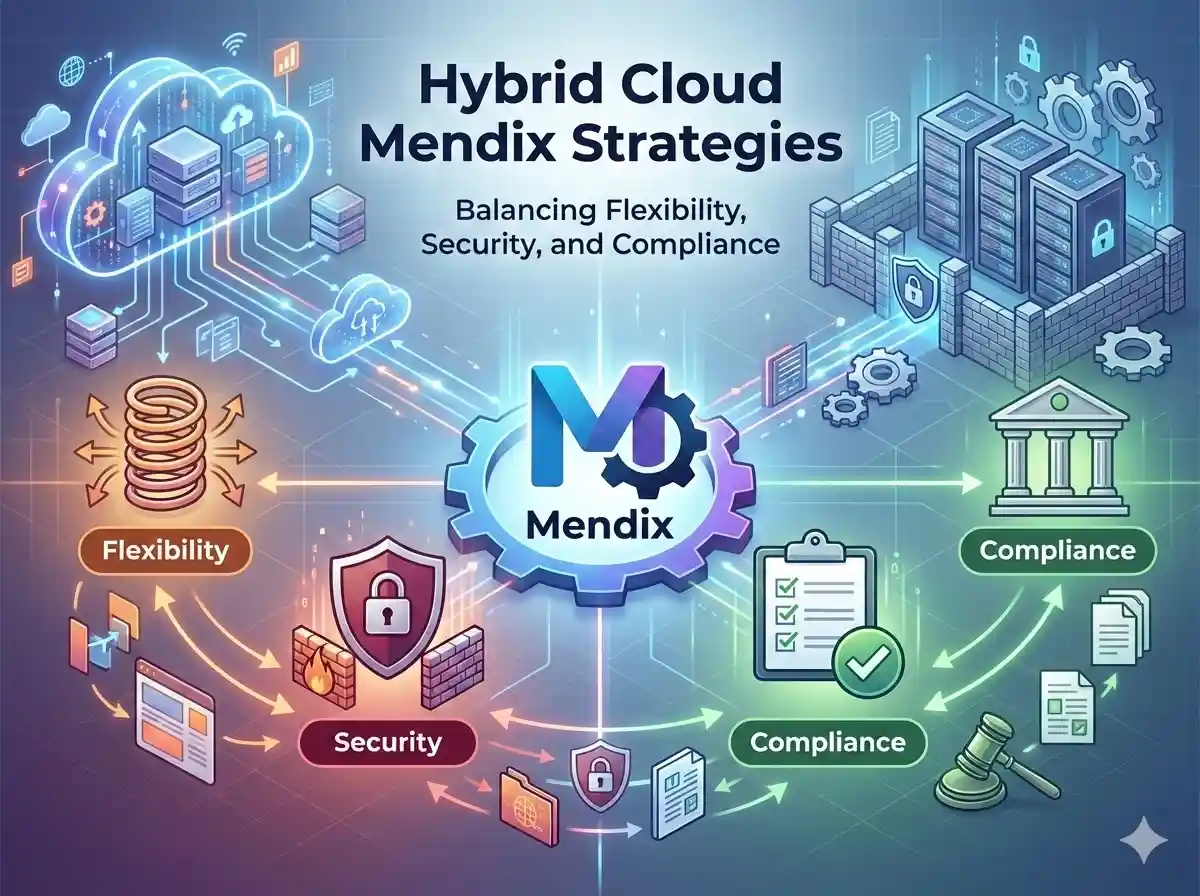
Enterprise cloud strategy is no longer a binary choice between on-premise and public cloud. For large organizations running mission-critical Mendix workloads, hybrid and multi-cloud architectures have become the strategic default.
But hybrid cloud adoption introduces a new layer of architectural complexity.
Enterprises must balance:
Flexibility and scalability
Regulatory compliance
Data sovereignty
Performance predictability
Security governance
When deploying Mendix across hybrid environments, the challenge is not simply infrastructure configuration. It is architectural alignment across distributed systems.
Why Hybrid Cloud Is Becoming the Enterprise Standard
Large enterprises operate under constraints that prevent full cloud centralization:
Regional data residency requirements
Legacy systems hosted on-premise
Industry-specific compliance frameworks
Long-term infrastructure contracts
Risk management policies
Hybrid cloud strategies allow organizations to modernize selectively while maintaining control where necessary.
For Mendix workloads, this typically means:
Customer-facing applications in public cloud
Sensitive data processing in private environments
Integration layers spanning both
Centralized governance across distributed deployments
Hybrid cloud is not a compromise. It is a structured response to enterprise complexity.
Architectural Principles for Hybrid Mendix Deployments
Deploying Mendix in hybrid environments requires deliberate architectural boundaries.
Key principles include:
1. Clear System Segmentation
Workloads should be divided based on sensitivity, compliance requirements, and performance characteristics.
For example:
UI and orchestration layers in public cloud
Core data stores in private cloud
Analytics pipelines in specialized environments
Segmentation reduces cross-environment latency and simplifies compliance audits.
2. API-Driven Integration as the Default
In hybrid environments, tight coupling between systems becomes fragile.
Instead, Mendix applications should:
Communicate via secure APIs
Avoid direct database dependencies across environments
Implement timeout and retry policies
Log cross-boundary transactions for traceability
Loose coupling is what allows hybrid systems to remain resilient.
3. Data Governance by Design
Hybrid cloud increases data flow complexity.
Enterprises must define:
Data classification policies
Encryption standards (at rest and in transit)
Regional storage rules
Backup and disaster recovery alignment
Without structured governance, hybrid architecture can unintentionally violate compliance standards.
Security Architecture Across Hybrid Environments
Security in hybrid deployments cannot rely solely on perimeter defenses.
Effective strategies include:
Zero-trust networking models
Role-based access across cloud boundaries
Federated identity management
Secure secret management systems
Continuous vulnerability monitoring
Mendix runtime configurations must align with enterprise IAM frameworks rather than operate independently.
Security consistency across environments is more important than security strength in a single environment.
Performance Considerations in Multi-Cloud Mendix Deployments
Performance tuning in hybrid cloud introduces new variables:
Network latency between environments
Cross-region data transfer overhead
Autoscaling inconsistencies
Distributed logging complexity
Architects must account for:
Geographic workload placement
Latency-sensitive transaction routing
Edge caching strategies
Asynchronous communication for non-critical operations
Hybrid cloud increases flexibility, but it also amplifies performance design mistakes.
Organizations working with experienced Mendix experts often conduct architectural performance reviews before hybrid scaling, ensuring that cloud flexibility does not compromise runtime stability.
Compliance Management in Distributed Cloud Models
Regulated industries face particular challenges when adopting hybrid cloud.
Compliance frameworks may require:
Audit trail immutability
Regional data isolation
Documented change management
Environment-level access controls
Hybrid architecture must provide:
Unified observability dashboards
Centralized compliance reporting
Consistent logging across clouds
Controlled deployment pipelines
Compliance becomes significantly harder when environments are fragmented without governance.
Hybrid strategy must prioritize visibility.
Multi-Cloud: Strategic Advantage or Operational Burden?
Some enterprises extend hybrid strategy into full multi-cloud deployments to avoid vendor lock-in or increase redundancy.
While multi-cloud provides:
Vendor diversification
Negotiation leverage
Redundancy benefits
It also introduces:
Increased operational complexity
Tool fragmentation
Skill distribution challenges
A mature hybrid Mendix strategy often focuses on controlled multi-cloud usage rather than full duplication of environments.
Architectural clarity prevents infrastructure sprawl.
Governance as the Core Enabler
Hybrid and multi-cloud deployments succeed when governance frameworks are clearly defined.
Effective governance includes:
Standardized deployment templates
Infrastructure-as-code policies
Controlled environment provisioning
Shared logging conventions
Cross-team architectural reviews
Without governance, hybrid cloud becomes an uncontrolled expansion of infrastructure.
A disciplined lowcode company operating in enterprise environments will prioritize governance models before expanding infrastructure footprint.
Observability Across Distributed Environments
Hybrid deployments require cross-environment observability.
Enterprises should ensure:
Correlated request IDs across clouds
Centralized log aggregation
Infrastructure and application metric integration
Alert thresholds aligned with business impact
Distributed architecture without unified visibility increases incident resolution time.
Hybrid cloud success depends on operational transparency.
The Strategic Outcome
When architected properly, hybrid cloud strategies allow enterprises to:
Modernize incrementally
Preserve regulatory alignment
Scale elastically
Reduce systemic risk
Maintain architectural optionality
Mendix is particularly well-suited for hybrid deployments due to its modular architecture and API-first design patterns.
However, flexibility without discipline leads to instability.
The real advantage of hybrid cloud is not simply infrastructure diversity. It is the ability to evolve strategically without forcing wholesale system replacement.
Conclusion
Hybrid cloud Mendix strategies are not about splitting workloads across environments randomly. They are about deliberate architectural alignment between flexibility, security, and compliance.
Enterprises that succeed in hybrid deployments focus on:
System segmentation
Governance consistency
API-driven integration
Observability maturity
Security standardization
Hybrid cloud is not inherently complex. Poor architecture is.
When designed with clarity and discipline, hybrid Mendix environments provide enterprises with the agility of the cloud and the control of traditional infrastructure — without compromising compliance or performance.
About the author

Ashok Kata
Ashok Kata is the Founder of We LowCode, a top low-code firm in Hampton, VA. With 14+ years in IT, he specializes in Mendix, OutSystems, Angular, and more. A certified Mendix Advanced Developer, he leads a skilled team delivering scalable, intelligent apps that drive rapid, cost-effective digital transformation.
Ashok Kata
Ashok Kata is the Founder of We LowCode, a top low-code firm in Hampton, VA. With 14+ years in IT, he specializes in Mendix, OutSystems, Angular, and more. A certified Mendix Advanced Developer, he leads a skilled team delivering scalable, intelligent apps that drive rapid, cost-effective digital transformation.
- Ashok K
- Ashok K

We help businesses accelerate digital transformation with expert Low-Code development services—delivering secure, scalable, and future-ready solutions.
Important Links
Contact us
Location
- Hampton, VA 23662 United States of America
Phone
- +1(512)-779-6895
Email us
- contact@welowcode.com