- contact@welowcode.com
- Hampton, VA 23662

Designing High-Performance Low-Code Applications
Enterprise-grade Mendix, SaaS and AI solutions built for scale.
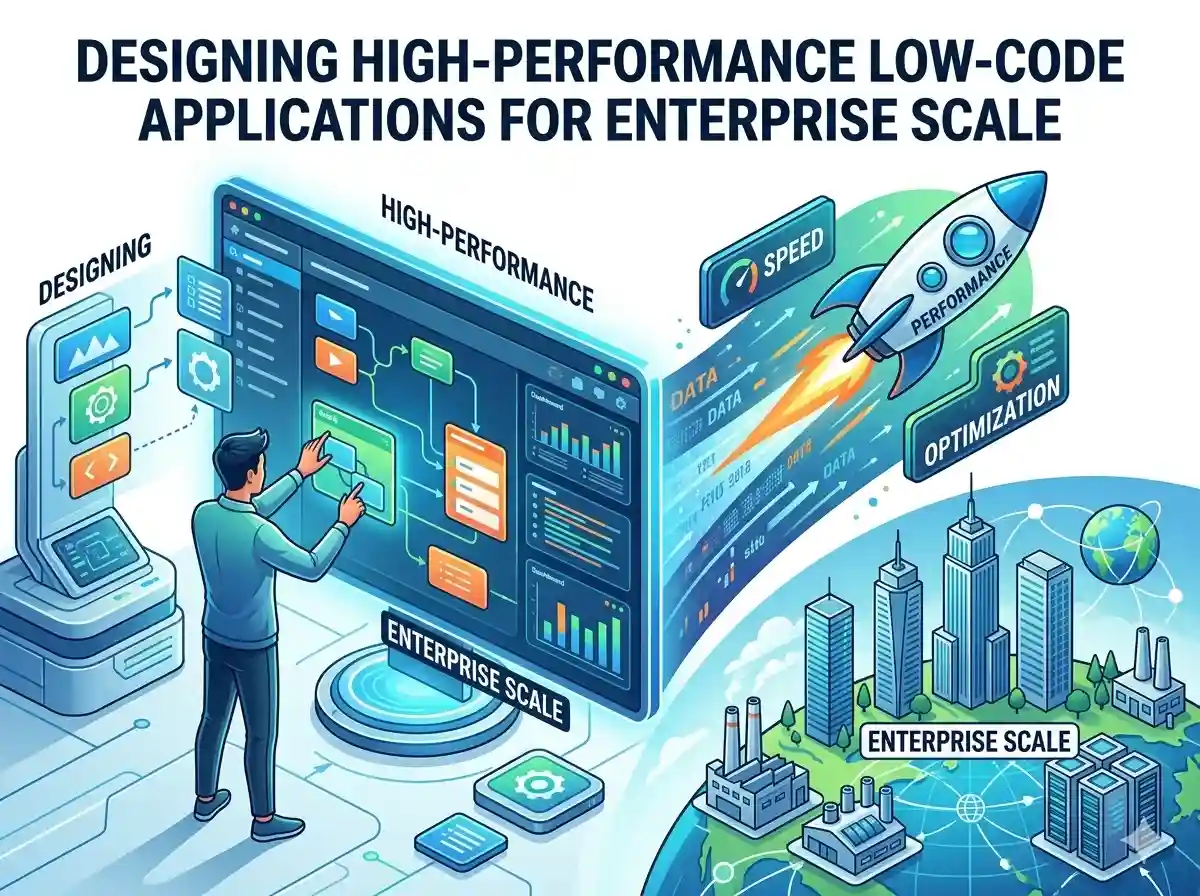
Modern enterprises are under constant pressure to deliver digital solutions quickly without compromising reliability or scalability. Traditional development approaches often struggle to keep up with rapidly evolving business requirements. As a result, organizations are increasingly adopting low-code platforms to accelerate application delivery while maintaining enterprise-grade performance.
However, speed alone is not enough. When applications serve thousands – or even millions – of users, performance becomes a critical factor. Designing high – performance low-code applications requires a thoughtful approach to architecture, data management, and scalability from the very beginning.
This article explores the key principles and strategies for designing enterprise-grade low-code applications that perform reliably at scale.
Why Performance Matters in Enterprise Low-Code Applications
Low-code platforms simplify development through visual modeling, reusable components, and automation. While these features accelerate delivery, application performance still depends heavily on how the solution is designed.
Enterprise applications typically need to handle:
Large volumes of transactional data
High concurrency with thousands of users
Multiple integrations with external systems
Complex business workflows
These requirements make performance optimization essential. If poorly designed, low-code applications can face bottlenecks in data processing, workflow execution, or integration layers. Optimizing architecture and resource management ensures the application remains responsive even under heavy workloads.
Build with a Scalable Architecture from Day One
One of the biggest mistakes organizations make is treating low-code platforms only as rapid prototyping tools. In reality, enterprise systems require a long-term architectural vision.
A scalable architecture should focus on modularity and separation of concerns. Instead of building a single monolithic application, developers should design smaller, loosely coupled modules that can evolve independently.
Common architecture practices include:
Microservices-based architecture for independent service scaling
Containerized deployments for flexible infrastructure management
Stateless services to allow horizontal scaling
API-first integration strategies for interoperability
These architectural patterns allow applications to expand as business needs grow while maintaining stability and performance.
Optimize Data Models for Performance
Data management plays a major role in application performance. Inefficient data models can quickly become the biggest source of latency in enterprise applications.
To maintain optimal performance:
Normalize data structures where necessary
Avoid unnecessary relationships in domain models
Index frequently queried data
Limit large data fetch operations
Use pagination and lazy loading for large datasets
Efficient data modeling ensures that the application retrieves only the necessary information instead of overloading the system with heavy queries.
Design Efficient Workflows and Business Logic
Enterprise applications often include complex workflows such as approvals, document processing, or supply chain operations. If workflows are not designed properly, they can create processing delays.
Best practices include:
Keeping microflows or process logic simple and modular
Reducing synchronous processing when possible
Using background processing for heavy tasks
Implementing asynchronous integrations
This approach reduces response time and ensures smoother user interactions.
Implement Caching and Load Balancing
As application traffic increases, infrastructure optimization becomes essential.
Key strategies include:
Caching:
Frequently accessed data should be cached to reduce repeated database queries.
Load balancing:
Distributing user requests across multiple instances prevents individual servers from becoming overloaded.
Auto-scaling:
Cloud infrastructure can automatically increase resources during peak usage.
These strategies ensure applications remain responsive even during high traffic spikes.
Monitor Performance Continuously
Performance optimization is not a one-time activity. Continuous monitoring allows teams to detect issues early and improve application stability.
Important monitoring metrics include:
Application response time
Database query performance
Integration latency
Server resource utilization
Error rates and system logs
Modern low-code platforms provide built-in monitoring tools that help developers identify bottlenecks and resolve them quickly.
Prioritize Reusability and Modular Design
Reusable components significantly improve both performance and maintainability.
By creating reusable UI components, integration connectors, and business logic modules, teams can:
Reduce redundant processing
Improve consistency across applications
Accelerate future development cycles
Modular design also allows developers to update specific components without impacting the entire system.
Enable Governance for Enterprise Low-Code Platforms
When multiple teams build applications on the same platform, governance becomes critical.
Organizations should define:
Architecture standards
Integration guidelines
performance benchmarks
Security policies
Deployment pipelines
Proper governance ensures that all applications maintain consistent performance and security standards as the platform scales.
The Role of Advanced Development Expertise
While low-code simplifies development, enterprise-grade implementations still require architectural expertise. Organizations often collaborate with a low-code development company to design scalable solutions and establish best practices.
Specialized teams can help enterprises implement robust solutions such as Mendix SaaS development, ensuring applications are optimized for cloud-native scalability and long-term maintainability.
In addition, many enterprises are integrating AI-powered capabilities into their platforms. Leveraging ai saas development services enables organizations to build intelligent automation, predictive analytics, and advanced decision-making features directly into their low-code applications.
Final Thoughts
Low-code platforms are transforming how enterprises build and deploy digital solutions. However, building applications quickly is only part of the equation. Designing for performance, scalability, and reliability is what ultimately determines long-term success.
By focusing on scalable architecture, efficient data modeling, modular workflows, and continuous monitoring, organizations can create low-code applications that perform seamlessly even under enterprise-scale workloads.
When implemented strategically, low-code becomes more than just a development shortcut—it becomes a powerful foundation for enterprise digital transformation.
About the author

Ashok Kata
Ashok Kata is the Founder of We LowCode, a top low-code firm in Hampton, VA. With 14+ years in IT, he specializes in Mendix, OutSystems, Angular, and more. A certified Mendix Advanced Developer, he leads a skilled team delivering scalable, intelligent apps that drive rapid, cost-effective digital transformation.
Ashok Kata
Ashok Kata is the Founder of We LowCode, a top low-code firm in Hampton, VA. With 14+ years in IT, he specializes in Mendix, OutSystems, Angular, and more. A certified Mendix Advanced Developer, he leads a skilled team delivering scalable, intelligent apps that drive rapid, cost-effective digital transformation.
- Ashok K
- Ashok K

We help businesses accelerate digital transformation with expert Low-Code development services—delivering secure, scalable, and future-ready solutions.
Contact us
Location
- Hampton, VA 23662 United States of America
Phone
- +1(512)-779-6895
Email us
- contact@welowcode.com