- contact@welowcode.com
- Hampton, VA 23662

Mendix + Generative AI User Experiences: Designing Intelligent Enterprise Applications
Enterprise applications have traditionally been designed around structured interfaces — dashboards, forms, workflows, and predefined logic.
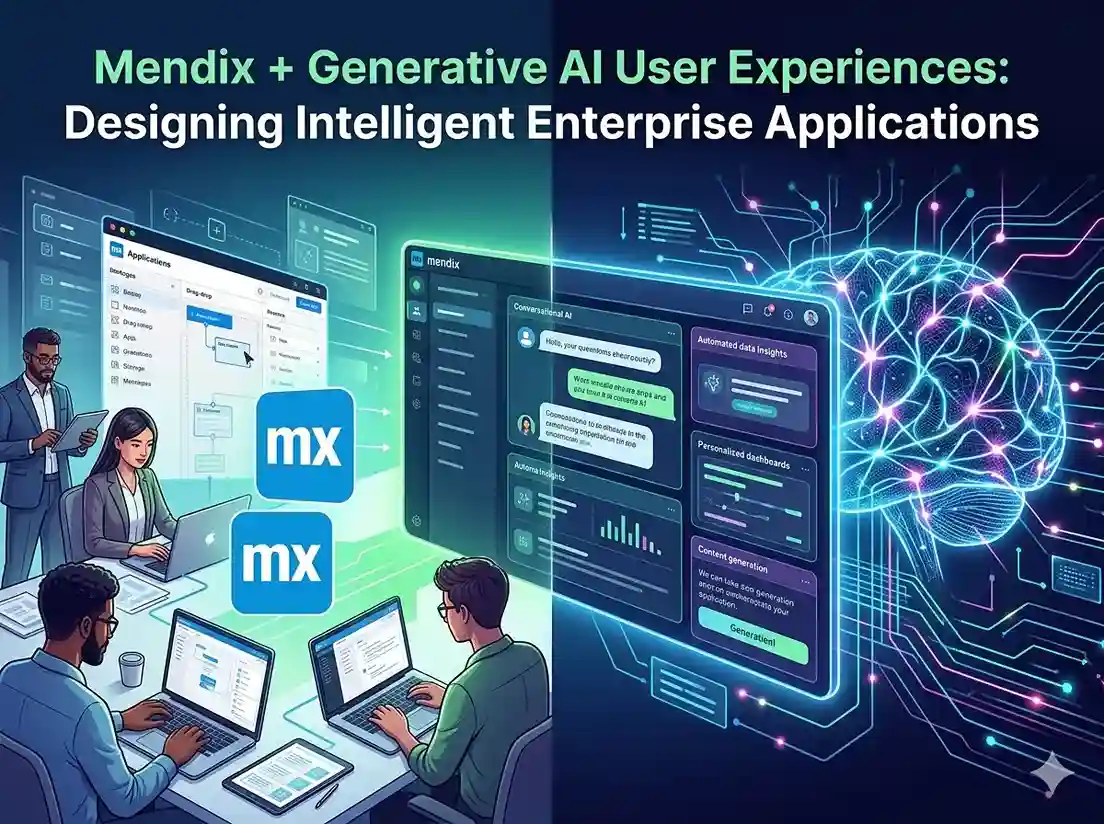
The Shift from Interfaces to Experiences
Enterprise applications have traditionally been designed around structured interfaces — dashboards, forms, workflows, and predefined logic.
These systems were built to ensure:
- Process consistency
- Data accuracy
- Operational control
However, they were never designed to adapt dynamically to users.
The emergence of generative AI changes this paradigm.
Instead of interacting with rigid interfaces, users now expect systems to:
- Understand intent
- Generate responses
- Adapt experiences in real time
This marks a shift from application design to experience design, where intelligence is embedded into how users interact with systems.
When combined with Mendix, generative AI enables enterprises to move beyond static applications and build systems that respond, evolve, and assist – not just execute.
Why Traditional UX Models Fall Short in the AI Era
Most enterprise UX frameworks are built on predictability.
They assume:
- Users follow defined paths
- Inputs are structured
- Outcomes are pre-programmed
Generative AI introduces variability.
Users can:
- Ask questions in natural language
- Request dynamic outputs
- Interact in non-linear ways
This creates friction when AI capabilities are layered onto traditional applications.
Common issues include:
- Disconnected AI features that do not integrate with workflows
- Inconsistent user experiences across different modules
- Limited ability to translate AI outputs into actionable steps
The result is an experience that feels fragmented rather than intelligent.
Rethinking UX: From Workflow-Driven to Intent-Driven Systems
To fully leverage generative AI, applications must shift from workflow-driven design to intent-driven design.
In this model:
- Users express what they want to achieve
- The system interprets intent
- Actions are generated dynamically
This requires:
- Tight integration between AI models and application logic
- Real-time processing of user input
- Flexible UI components that adapt based on context
Mendix provides a strong foundation for this transition by enabling rapid development of adaptive interfaces and seamless integration with AI services.
Where Mendix Fits in Generative AI Experience Design
Mendix enables enterprises to operationalize generative AI within business applications.
Rather than building AI systems separately, organizations can embed intelligence directly into workflows.
Through structured Mendix consulting, enterprises can design applications where:
- AI outputs are directly linked to business processes
- User interactions trigger intelligent responses
- Decision-making becomes part of the application experience
This ensures that AI is not isolated but integrated into the core system.
Architectural Model for Generative AI Experiences
Building AI-driven user experiences requires a layered architecture that connects intelligence with execution.
1. Interaction Layer: Natural User Interfaces
This layer handles:
- Conversational inputs
- Dynamic prompts
- Adaptive UI components
Instead of static forms, users interact with the system through flexible interfaces that adjust based on context.
2. Intelligence Layer: Generative AI Models
This layer is responsible for:
- Understanding user intent
- Generating responses
- Producing actionable outputs
It includes large language models and other generative systems that drive the experience.
3. Application Logic Layer: Business Context
AI outputs must be grounded in business logic.
This layer ensures that:
- Responses align with organizational rules
- Generated actions are valid within workflows
- Data integrity is maintained.
4. Execution Layer: Workflow Integration
The final layer translates insights into action.
This includes:
- Triggering workflows
- Updating systems
- Executing decisions
Without this layer, AI remains advisory rather than operational.
Designing Practical Generative AI Use Cases in Mendix
Generative AI becomes valuable when it enhances real business workflows.
1. Intelligent Process Assistants
Applications can provide real-time assistance by:
- Suggesting next steps in workflows
- Generating documentation
- Guiding users through complex processes
This reduces dependency on training and improves efficiency.
2. Dynamic Content Generation
Enterprises can automate:
- Report creation
- Customer communication
- Internal documentation
This ensures consistency while reducing manual effort.
3. Decision Support Systems
Generative AI can:
- Analyze data
- Provide recommendations
- Explain reasoning
This enables faster and more informed decision-making.
4. Personalized User Experiences
Applications can adapt based on:
- User roles
- Behavior patterns
- Historical data
This creates a more intuitive and efficient experience.
Bridging the Gap Between AI Output and Business Action
One of the biggest challenges in generative AI adoption is the gap between output and execution.
AI can generate insights, but without integration, those insights remain unused.
Mendix addresses this by:
- Embedding AI outputs directly into workflows
- Enabling real-time action based on generated insights
- Ensuring that responses are context-aware
With the right approach to low code consulting, enterprises can ensure that AI capabilities translate into measurable business outcomes rather than isolated features.
Managing Complexity in AI-Driven Experiences
Generative AI introduces new layers of complexity that must be managed carefully.
Consistency of Output
AI-generated responses must align with:
- Brand guidelines
- Business rules
- Compliance requirements
User Trust and Transparency
Users need to understand:
- How decisions are made
- When AI is involved
- What level of accuracy to expect
Performance and Scalability
AI-driven applications must:
- Handle large volumes of interactions
- Maintain response speed
- Scale without degradation
Governance and Control
Enterprises must establish:
- Guidelines for AI usage
- Monitoring mechanisms
- Continuous improvement processes
The Role of AI Strategy in Experience Design
Technology alone does not create value.
Enterprises must define:
- Where AI adds the most value
- How it integrates with existing systems
- What outcomes it is expected to drive
Working with an experienced ai app development company ensures that:
- AI initiatives are aligned with business objectives
- Implementation is structured and scalable
- Long-term value is prioritized over short-term experimentation
Avoiding Common Mistakes in Generative AI UX
Organizations often make similar mistakes when integrating generative AI:
- Treating AI as a feature rather than a system capability
- Over-automating without understanding user needs
- Ignoring the importance of workflow integration
- Focusing on novelty instead of practical value
Avoiding these pitfalls requires a clear understanding of both technology and user behavior.
When Generative AI Delivers Maximum Impact
Generative AI user experiences are most effective when:
- Processes involve high cognitive effort
- Decision-making requires interpretation of complex data
- User interactions are frequent and varied
- Efficiency gains directly impact business performance
In such scenarios, AI becomes a force multiplier rather than a supplementary tool.
Strategic Implication: From Applications to Intelligent Systems
The integration of generative AI with Mendix represents a broader shift.
Enterprises move from:
- Building applications that execute predefined logic
To:
- Designing systems that understand, adapt, and assist
This shift enables:
- Faster decision-making
- Improved user productivity
- Continuous system evolution
Conclusion: Designing Experiences That Think
Generative AI is redefining how users interact with enterprise systems.
The focus is no longer on building applications that function correctly, but on creating experiences that:
- Understand intent
- Provide meaningful responses
- Enable action
Mendix provides the flexibility to integrate these capabilities into real business workflows.
Organizations that adopt this approach will not only improve user experience but also unlock new levels of efficiency and innovation.
At We LowCode, generative AI experiences are designed as integrated, scalable systems that align intelligence with enterprise workflows, enabling businesses to move beyond static applications and build truly adaptive digital platforms.
About the author

Ashok Kata
Ashok Kata is the Founder of We LowCode, a top low-code firm in Hampton, VA. With 14+ years in IT, he specializes in Mendix, OutSystems, Angular, and more. A certified Mendix Advanced Developer, he leads a skilled team delivering scalable, intelligent apps that drive rapid, cost-effective digital transformation.
Ashok Kata
Ashok Kata is the Founder of We LowCode, a top low-code firm in Hampton, VA. With 14+ years in IT, he specializes in Mendix, OutSystems, Angular, and more. A certified Mendix Advanced Developer, he leads a skilled team delivering scalable, intelligent apps that drive rapid, cost-effective digital transformation.
- Ashok K
- Ashok K

We help businesses accelerate digital transformation with expert Low-Code development services—delivering secure, scalable, and future-ready solutions.
Contact us
Location
- Hampton, VA 23662 United States of America
Phone
- +1(512)-779-6895
Email us
- contact@welowcode.com