- contact@welowcode.com
- Hampton, VA 23662

Custom React Widgets in Mendix: Building Dynamic, Reusable UI Components
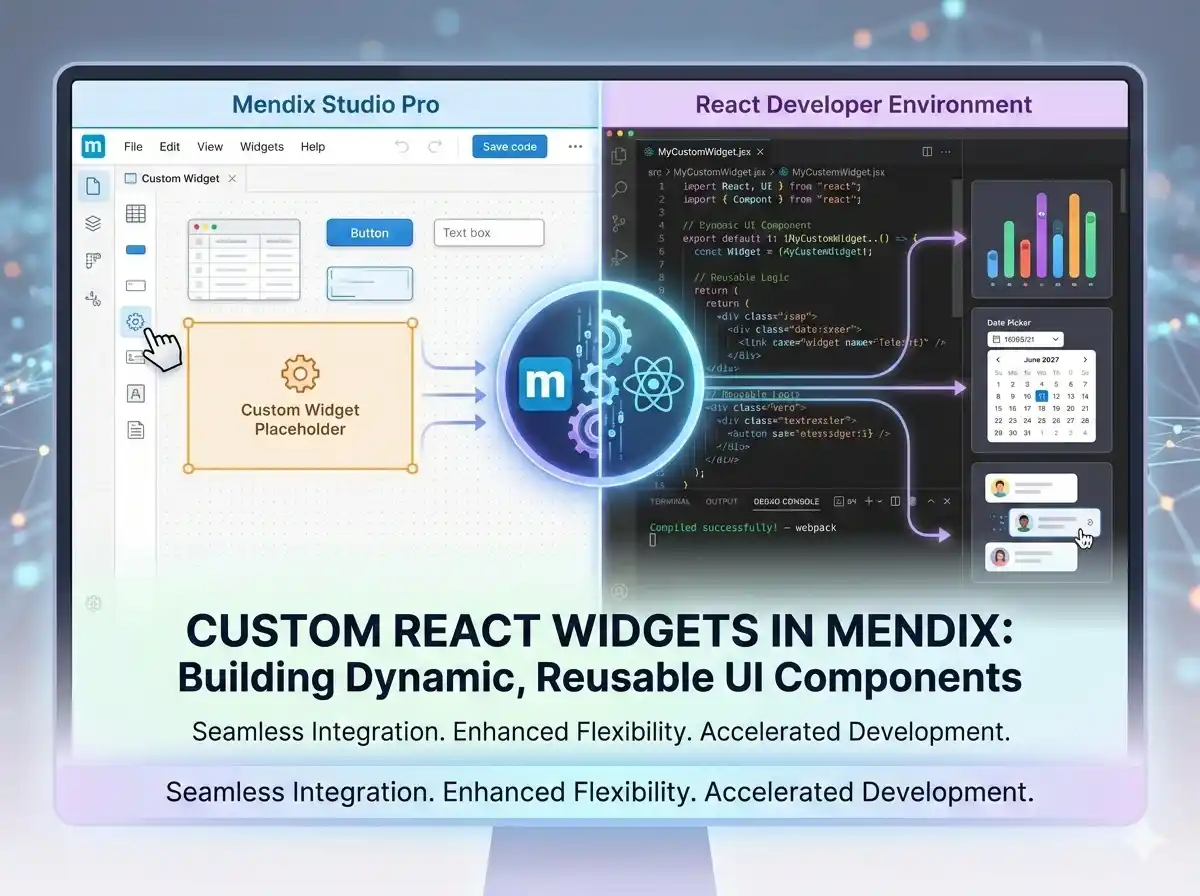
Modern enterprise applications are no longer judged solely on functionality. User experience, responsiveness, and interface consistency play an equally critical role in adoption and long-term success. While Mendix provides a rich set of out-of-the-box UI components, enterprise teams frequently reach a point where standard widgets are no longer sufficient.
This is where custom React widgets become a powerful extension mechanism. By combining Mendix’s low-code backend with advanced front-end customization using React, TypeScript, and Pluggable Widgets, teams can deliver dynamic, reusable UI components that meet enterprise-grade design and interaction requirements.
This article explores how custom React widgets fit into Mendix architecture, when to use them, and how to build them responsibly for scalable, maintainable applications.
Why Enterprises Go Beyond Standard Mendix Widgets
Out-of-the-box Mendix widgets are designed for rapid delivery and broad use cases. They work exceptionally well for common patterns such as forms, tables, and basic interactions. However, enterprise applications often demand more.
Common reasons teams move toward custom widgets include:
Complex UI interactions not supported natively
Integration with third-party JavaScript libraries
Highly branded or design-system-driven interfaces
Performance-critical UI components
Reusable components shared across multiple apps
In these scenarios, extending Mendix with React allows teams to maintain visual and behavioral consistency without compromising backend simplicity.
Understanding Pluggable Widgets in Mendix
Pluggable Widgets are Mendix’s official mechanism for building custom UI components using modern front-end technologies. They act as a bridge between Mendix’s low-code model and React-based interfaces.
At a high level, Pluggable Widgets:
Are built using React and TypeScript
Expose configurable properties to Mendix Studio Pro
Interact with Mendix data via generated APIs
Can be reused across multiple applications
This architecture ensures that front-end customization remains structured rather than ad-hoc.
Why React and TypeScript Are the Preferred Stack
Mendix chose React and TypeScript for Pluggable Widgets for good reason.
React
React’s component-based architecture aligns naturally with reusable UI development. It enables:
Encapsulation of UI logic
Predictable rendering behavior
Strong ecosystem support
TypeScript
TypeScript adds:
Compile-time safety
Clear contracts between widget properties and Mendix data
Better long-term maintainability
Together, they create a foundation suitable for enterprise-grade UI components.
Where Custom React Widgets Fit Architecturally
Custom widgets should be treated as presentation and interaction layers, not business logic engines.
A well-designed Mendix architecture typically follows this pattern:
Mendix handles workflows, data, and security
Microflows manage business rules and orchestration
React widgets focus on rendering and interaction
This separation ensures that UI customization does not introduce hidden complexity or duplicate logic.
Designing Reusable Widgets for Enterprise Scale
Reusability is one of the biggest advantages of custom widgets—when done correctly.
Best practices include:
Designing widgets to be configuration-driven rather than hardcoded
Supporting optional behavior through properties
Avoiding assumptions about specific domain models
Documenting intended use cases clearly
Reusable widgets reduce duplication and speed up development across teams.
Managing Data Flow Between Mendix and React
One of the most critical aspects of widget development is understanding how data flows between Mendix and React.
Key considerations:
Use Mendix-provided data APIs rather than custom fetch logic
Minimize round-trips by passing only required data
Avoid heavy computation inside widgets
Let Mendix handle validation and persistence
Efficient data handling directly impacts UI performance and responsiveness.
Performance Considerations in Custom Widgets
While React is powerful, poorly designed widgets can negatively impact performance.
Common pitfalls include:
Excessive re-rendering
Large data sets passed unnecessarily
Blocking UI interactions with synchronous logic
Performance-aware widget design focuses on:
Memoization where appropriate
Lean property models
Predictable rendering paths
Enterprise applications benefit significantly from disciplined front-end optimization.
Security and Governance Implications
Custom widgets introduce JavaScript into the application landscape, which makes governance essential.
Enterprises should:
Maintain a vetted widget library
Enforce code reviews and versioning
Restrict direct DOM manipulation
Align widget development with security policies
A seasoned Mendix Expert understands that governance is what makes customization sustainable at scale.
When Custom Widgets Are Not the Right Choice
Despite their power, custom widgets are not always necessary.
Avoid building custom widgets when:
Standard Mendix components already meet requirements
UI complexity is low
The widget would only be used once
Maintenance effort outweighs benefits
Custom widgets should solve recurring, high-impact problems—not serve as default solutions.
Collaboration Between Front-End and Low-Code Teams
One of the most successful patterns in enterprise Mendix projects is collaboration between:
Low-code developers
Front-end specialists
UX designers
Custom widgets allow each role to contribute within their expertise without overlapping responsibilities. This collaboration is often guided by a low code expert who understands both the platform and modern front-end practices.
Testing and Maintenance Strategy
Custom widgets require the same rigor as any other code artifact.
Recommended practices include:
Unit testing React components
Manual UI testing in multiple Mendix contexts
Versioned releases of widgets
Clear deprecation policies
Treating widgets as first-class software components ensures long-term reliability.
Supporting Design Systems and Brand Consistency
Many enterprises adopt design systems to maintain consistency across applications. Custom React widgets are ideal for enforcing these standards.
Widgets can:
Encapsulate brand styles
Standardize interaction patterns
Reduce visual inconsistencies
This approach ensures that low-code applications align with broader digital experiences.
Balancing Flexibility and Simplicity
The biggest risk in widget development is over-engineering.
Successful teams aim for:
Clear purpose per widget
Minimal configuration surface
Predictable behavior
Flexibility should serve reuse—not complexity.
The Strategic Value of Custom UI in Mendix
Custom React widgets elevate Mendix from a rapid application platform to a fully extensible enterprise UI framework. They allow organizations to:
Meet advanced UX requirements
Integrate modern front-end capabilities
Scale design consistency across apps
When used judiciously, they enhance—not undermine—the benefits of low-code development.
Conclusion
Custom React widgets represent the intersection of low-code efficiency and modern front-end engineering. They enable enterprises to push beyond standard UI capabilities while preserving the core strengths of the Mendix platform.
By treating widgets as reusable, governed components and maintaining a clear separation of concerns, organizations can deliver dynamic, high-performance user experiences without sacrificing maintainability.
Advanced front-end customization in Mendix is not about replacing low-code—it’s about extending it intelligently. When aligned with enterprise architecture and supported by the right expertise, custom widgets become a strategic advantage rather than a technical liability.
About the author

Ashok Kata
Ashok Kata is the Founder of We LowCode, a top low-code firm in Hampton, VA. With 14+ years in IT, he specializes in Mendix, OutSystems, Angular, and more. A certified Mendix Advanced Developer, he leads a skilled team delivering scalable, intelligent apps that drive rapid, cost-effective digital transformation.
Ashok Kata
Ashok Kata is the Founder of We LowCode, a top low-code firm in Hampton, VA. With 14+ years in IT, he specializes in Mendix, OutSystems, Angular, and more. A certified Mendix Advanced Developer, he leads a skilled team delivering scalable, intelligent apps that drive rapid, cost-effective digital transformation.
- Ashok K
- Ashok K

We help businesses accelerate digital transformation with expert Low-Code development services—delivering secure, scalable, and future-ready solutions.
Contact us
Location
- Hampton, VA 23662 United States of America
Phone
- +1(512)-779-6895
Email us
- contact@welowcode.com