- contact@welowcode.com
- Hampton, VA 23662

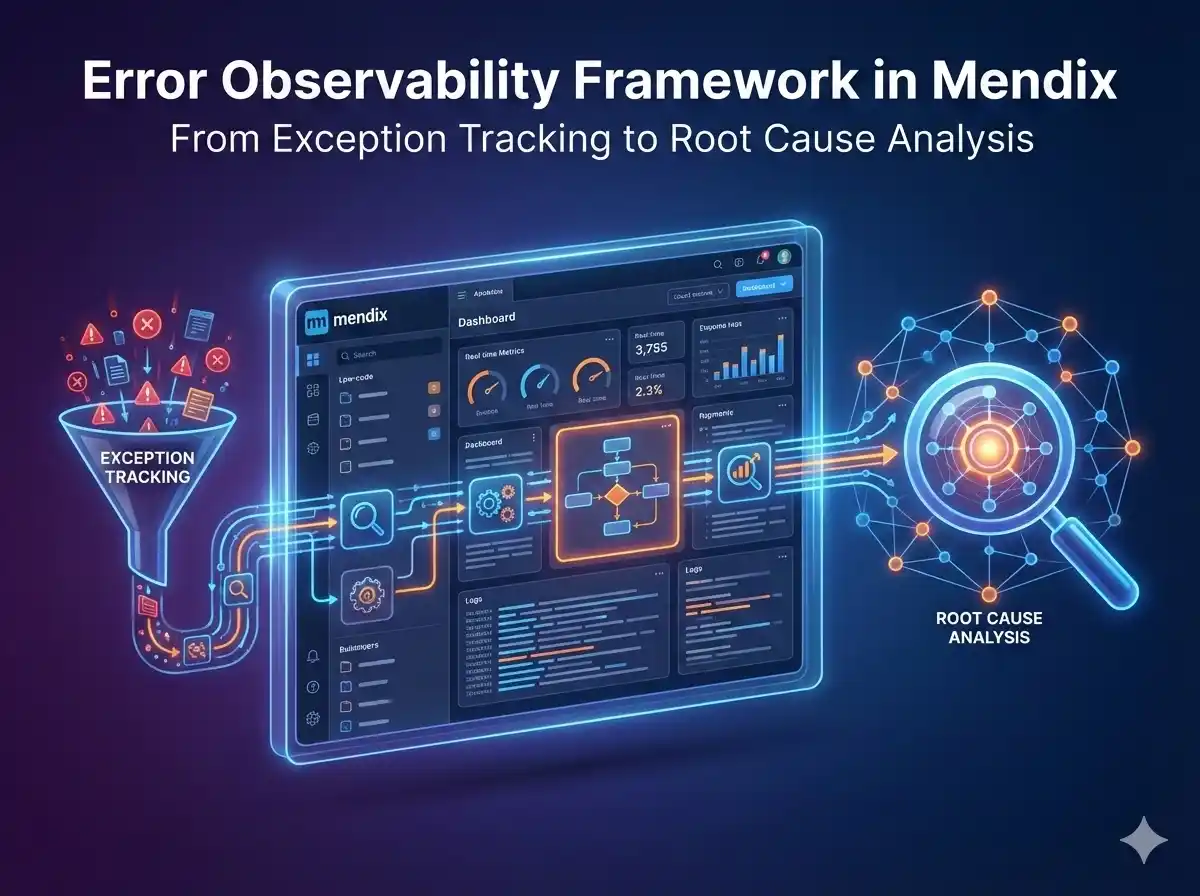
Error Observability Framework in Mendix: From Exception Tracking to Root Cause Analysis
Enterprise Mendix applications rarely fail dramatically. They degrade quietly.
A slow response time here.
An intermittent integration error there.
A background job that retries endlessly without visibility.
In large-scale environments, these “minor” issues compound. What begins as a recoverable exception can evolve into operational instability, frustrated users, and blind debugging cycles.
This is why modern enterprise teams are moving beyond traditional exception logging toward a structured error observability framework in Mendix—one that connects runtime signals, dashboards, and alerting into a cohesive system for root cause analysis.
Observability is not about logging more. It’s about designing your application to be diagnosable.
Why Exception Tracking Alone Is Not Enough
Most Mendix applications start with basic error handling:
Try-catch patterns in microflows
Logging nodes with error levels
Generic user-friendly messages
While necessary, these mechanisms are reactive. They capture symptoms, not context.
In enterprise cloud environments, the real challenge is answering:
Which user action triggered the failure?
What data state existed at the time?
Was this an isolated issue or systemic?
Did a downstream dependency cause it?
Without contextual visibility, troubleshooting becomes guesswork.
From Logging to Observability
Observability differs from logging in one critical way: it enables you to infer system behavior from structured signals.
An effective Mendix observability framework includes:
Structured exception logging
Correlation IDs across services
Execution timing metrics
Context-aware dashboards
Alert thresholds aligned to business impact
This layered approach transforms isolated errors into traceable events within a larger execution narrative.
Designing a Structured Error-Handling Pattern in Mendix
Enterprise-grade Mendix applications treat error handling as an architectural layer—not a microflow afterthought.
A robust pattern typically includes:
Centralized Error Microflows
Instead of handling exceptions individually, applications route failures to centralized error-handling logic. This ensures:
Consistent formatting
Standard metadata capture
Controlled escalation paths
Context Capture
Each error event should log:
User ID (when applicable)
Transaction or request ID
Input parameters
Execution path
Environment details
This transforms raw errors into actionable intelligence.
Severity Classification
Not all errors deserve the same treatment. Structured classification helps:
Separate critical failures from recoverable issues
Trigger appropriate alert levels
Avoid alert fatigue
These patterns significantly reduce mean time to resolution (MTTR).
Correlation IDs: The Foundation of Root Cause Analysis
In cloud-native and distributed environments, requests often pass through:
APIs
External services
Background jobs
Integration layers
Without correlation IDs, tracing failures across these boundaries becomes nearly impossible.
By generating and propagating correlation identifiers within Mendix:
Logs across services become linkable
Dashboards can group related events
Root cause patterns emerge more clearly
Correlation is what turns fragmented logs into a coherent diagnostic narrative.
Building Observability Dashboards for Mendix Applications
Raw logs do not scale. Enterprise operations teams require dashboards that surface patterns visually.
Effective Mendix observability dashboards typically track:
Exception frequency trends
Error rates by module
Integration latency spikes
Background job failures
User-impacting incidents
Dashboards should answer:
Is the system stable right now?
Are errors increasing over time?
Which components generate the most failures?
When dashboards are aligned to business workflows—not just technical modules—they become decision-making tools rather than monitoring screens.
Alerting Without Noise
Alerting is where many systems fail.
If every error triggers a notification, teams quickly ignore alerts. Effective alerting strategies focus on:
Threshold-based triggers (e.g., error rate > X%)
Repeated failure patterns
Critical workflow interruptions
Infrastructure-related degradations
Smart alerting prioritizes impact, not occurrence.
Cloud Infrastructure Considerations
Observability in Mendix cannot be separated from infrastructure.
In cloud deployments:
Auto-scaling may mask underlying performance degradation
Network latency can introduce intermittent errors
Container restarts may hide transient failures
A mature framework integrates:
Application logs
Infrastructure metrics
Database health indicators
External dependency monitoring
True root cause analysis often lies at the intersection of application and infrastructure layers.
Exception Patterns That Scale Poorly
Across enterprise environments, several recurring anti-patterns appear:
Catching exceptions without logging sufficient context
Swallowing errors to “avoid user disruption”
Logging excessive details without structure
Relying solely on runtime console logs
These practices delay detection and obscure root causes.
Organizations working with experienced Mendix experts typically identify and eliminate these patterns early, establishing consistent architectural standards that scale safely.
Observability as a Cultural Discipline
Technology alone does not create observability. Teams must adopt:
Shared logging conventions
Defined ownership of error resolution
Clear escalation paths
Continuous improvement loops
In many enterprises, a senior low code expert helps bridge platform-level practices with operational maturity, ensuring that observability is not treated as a temporary initiative.
Observability becomes sustainable when it is embedded into the delivery lifecycle—not retrofitted after incidents.
From Reactive Debugging to Proactive Insight
The real value of an error observability framework lies not in fixing issues faster—but in predicting and preventing them.
With structured dashboards and trend monitoring, teams can:
Identify modules with rising instability
Detect integration degradation early
Anticipate scaling limits
Adjust architectural boundaries before failure occurs
Proactive insight transforms operations from firefighting to resilience engineering.
Designing for Failure Tolerance
Enterprise Mendix systems must assume that:
External services will fail
Network latency will fluctuate
Data inconsistencies will occur
User input will be unpredictable
A well-designed observability framework supports:
Graceful degradation strategies
Retry mechanisms with visibility
Circuit breaker patterns
Human override capabilities
The goal is not to eliminate failure—it is to manage it intelligently.
Measuring Observability Maturity
Enterprises can assess observability maturity by asking:
Can we trace a failure from user action to database state?
Do alerts correlate to business impact?
Can we identify recurring patterns without manual log review?
Do we detect issues before users report them?
If the answer to these questions is inconsistent, observability likely remains incomplete.
Why Observability Defines Enterprise Readiness
As Mendix adoption expands into mission-critical systems, observability becomes a defining capability.
Applications that:
Scale across regions
Support thousands of users
Integrate with multiple systems
Operate under regulatory oversight
…require more than exception logs. They require structured insight into system behavior.
An error observability framework is not optional in such environments—it is foundational.
Conclusion
Error observability in Mendix is a shift from reactive exception handling to structured, cloud-aware system insight. It connects microflow design, integration patterns, dashboards, and infrastructure signals into a cohesive framework for root cause analysis.
Enterprises that invest in observability early gain:
Faster incident resolution
Reduced operational risk
Higher system resilience
Improved architectural clarity
As Mendix applications continue to power critical enterprise workflows, the ability to diagnose, interpret, and anticipate system behavior will separate stable platforms from fragile ones.
Observability is not a feature. It is an architectural commitment to understanding how your application behaves—especially when it fails.
About the author

Ashok Kata
Ashok Kata is the Founder of We LowCode, a top low-code firm in Hampton, VA. With 14+ years in IT, he specializes in Mendix, OutSystems, Angular, and more. A certified Mendix Advanced Developer, he leads a skilled team delivering scalable, intelligent apps that drive rapid, cost-effective digital transformation.
Ashok Kata
Ashok Kata is the Founder of We LowCode, a top low-code firm in Hampton, VA. With 14+ years in IT, he specializes in Mendix, OutSystems, Angular, and more. A certified Mendix Advanced Developer, he leads a skilled team delivering scalable, intelligent apps that drive rapid, cost-effective digital transformation.
- Ashok K
- Ashok K

We help businesses accelerate digital transformation with expert Low-Code development services—delivering secure, scalable, and future-ready solutions.
Contact us
Location
- Hampton, VA 23662 United States of America
Phone
- +1(512)-779-6895
Email us
- contact@welowcode.com