- contact@welowcode.com
- Hampton, VA 23662

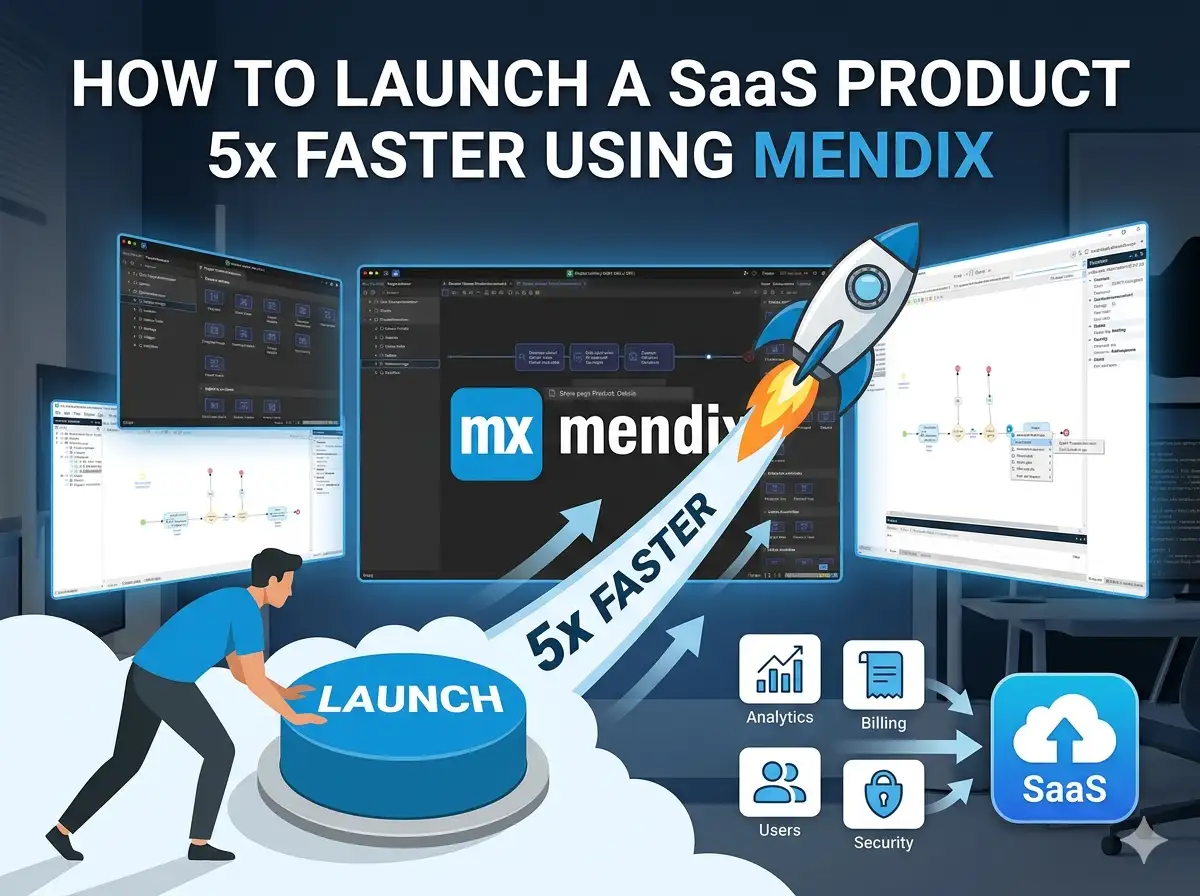
How to Launch a SaaS Product 5x Faster Using Mendix
Learn how to launch SaaS products faster using Mendix with the right architecture, strategy, and scalable development approach for enterprise growth.
Speed is No Longer an Advantage — It Is a Requirement
In SaaS markets, the difference between success and irrelevance is often measured in months.
Enterprises no longer compete only on product capability. They compete on how quickly they can:
- Validate ideas
- Launch usable products
- Adapt based on real-world feedback
Yet, most SaaS initiatives are delayed not by lack of vision, but by execution constraints. Traditional development models introduce friction at every stage — from architecture decisions to deployment cycles.
The result is predictable: by the time the product is ready, the market has already moved.
The real opportunity lies in rethinking how SaaS products are built, not just how they are designed.
Why Traditional SaaS Development Slows Down Execution
Most SaaS platforms are still developed using approaches optimized for stability, not speed.
This creates structural bottlenecks:
Extended Development Cycles
Large codebases require longer build and testing phases. Even minor changes trigger cascading dependencies, slowing down iteration.
Rigid Architecture Decisions
Early architectural choices become difficult to modify later, limiting flexibility as the product evolves.
Fragmented Development Workflows
Multiple teams working across frontend, backend, and infrastructure create coordination overhead that delays delivery.
Delayed Feedback Loops
User feedback often comes too late in the cycle, leading to rework and missed expectations.
These factors collectively reduce the organization’s ability to respond to market signals.
The Shift: From Code-Centric to Model-Driven SaaS Development
To achieve meaningful acceleration, enterprises must move away from code-heavy execution toward model-driven development.
This is where Mendix SaaS development introduces a fundamentally different approach.
Instead of building systems line by line, teams define:
- Application logic
- User interfaces
- Data relationships
through visual models that can be rapidly deployed and iterated.
This shift reduces the gap between concept and execution, allowing organizations to focus on delivering value rather than managing complexity.
Architectural Decisions That Enable 5x Faster Launch
Speed in SaaS development is not achieved through tools alone. It is the outcome of deliberate architectural choices.
1. Designing for Modularity from Day One
Monolithic architectures create long-term constraints. A modular approach allows:
- Independent development of features
- Parallel execution across teams
- Faster release cycles
Each module can evolve without impacting the entire system, enabling continuous progress.
2. Prioritizing Core Value Over Feature Completeness
Many SaaS products are delayed because teams attempt to deliver a fully featured solution in the first release.
A more effective approach is:
- Identify high-impact use cases
- Build only what is necessary for validation
- Expand based on real usage
This reduces initial development time while improving alignment with market needs.
3. Establishing Reusable Components
Reusable logic and components significantly reduce development effort over time.
This includes:
- Authentication systems
- Workflow engines
- Data processing modules
With reuse, each new feature builds on existing capabilities rather than starting from scratch.
4. Integrating Systems Instead of Rebuilding Them
SaaS products often need to interact with existing enterprise systems.
Rebuilding these systems is time-consuming and unnecessary.
Instead:
- Use integration layers to connect with existing infrastructure
- Focus development on new capabilities
- Reduce duplication of effort
This approach accelerates delivery while maintaining continuity.
The Role of Execution Strategy in Accelerating Delivery
Even with the right platform, execution strategy determines whether speed is realized.
A structured approach includes:
- Short development cycles with continuous releases
- Early user involvement for feedback
- Alignment between business objectives and technical implementation
- Clear ownership of product decisions
This is where expert low code consulting becomes critical. It ensures that development is guided by a clear strategy rather than reactive decision-making.
Embedding Intelligence Early in the Product Lifecycle
Modern SaaS products are expected to do more than execute processes. They are expected to provide insights.
By working with an experienced AI App Development Company, organizations can integrate intelligence from the beginning.
This includes:
- Predictive recommendations based on user behavior
- Automated decision-making in workflows
- Data-driven personalization
Embedding intelligence early avoids the need for costly retrofitting later and enhances product value from the first release.
Reducing Iteration Cost: The Real Driver of Speed
One of the most overlooked factors in SaaS development is the cost of change.
In traditional environments:
- Changes require code updates
- Testing cycles are extended
- Deployment becomes complex
This discourages frequent iteration.
In a low-code environment:
- Changes can be implemented quickly
- Testing cycles are shorter
- Deployment is streamlined
As a result, teams can iterate more frequently, which directly impacts time-to-market.
Aligning Product Development with Business Outcomes
Speed without direction leads to inefficiency.
High-performing SaaS teams align development efforts with measurable business outcomes, such as:
- Customer acquisition
- Retention rates
- Operational efficiency
This alignment ensures that every release contributes to business value rather than just feature expansion.
Scaling Without Rebuilding
A major risk in rapid SaaS development is building systems that cannot scale.
To avoid this, scalability must be built into the architecture from the beginning:
- Flexible data models
- Efficient resource utilization
- Scalable deployment strategies
Mendix supports this through its ability to handle evolving requirements without requiring complete system redesign.
This allows organizations to scale their product without slowing down development.
When 5x Faster Launch Becomes Achievable
Achieving a significant acceleration in SaaS launch timelines requires the convergence of multiple factors:
- Adoption of a model-driven development approach
- Strong architectural foundations
- Efficient execution strategy
- Continuous iteration and feedback
- Early integration of intelligent capabilities
When these elements are aligned, speed becomes a natural outcome rather than an aspirational goal.
Conclusion: Building SaaS Products That Move at Market Speed
Launching a SaaS product 5x faster is not about working harder — it is about working differently.
Organizations that rethink their development approach can:
- Reduce time-to-market
- Improve product-market fit
- Maintain flexibility as the product evolves
The advantage lies not just in faster delivery, but in the ability to continuously adapt and improve.
At We LowCode, SaaS development is approached as a strategic process — combining structured execution, scalable architecture, and modern platforms to help enterprises launch and grow with confidence.
About the author

Ashok Kata
Ashok Kata is the Founder of We LowCode, a top low-code firm in Hampton, VA. With 14+ years in IT, he specializes in Mendix, OutSystems, Angular, and more. A certified Mendix Advanced Developer, he leads a skilled team delivering scalable, intelligent apps that drive rapid, cost-effective digital transformation.
Ashok Kata
Ashok Kata is the Founder of We LowCode, a top low-code firm in Hampton, VA. With 14+ years in IT, he specializes in Mendix, OutSystems, Angular, and more. A certified Mendix Advanced Developer, he leads a skilled team delivering scalable, intelligent apps that drive rapid, cost-effective digital transformation.
- Ashok K
- Ashok K

We help businesses accelerate digital transformation with expert Low-Code development services—delivering secure, scalable, and future-ready solutions.
Contact us
Location
- Hampton, VA 23662 United States of America
Phone
- +1(512)-779-6895
Email us
- contact@welowcode.com