- contact@welowcode.com
- Hampton, VA 23662

Low-Code Governance Models: Balancing Speed & Control
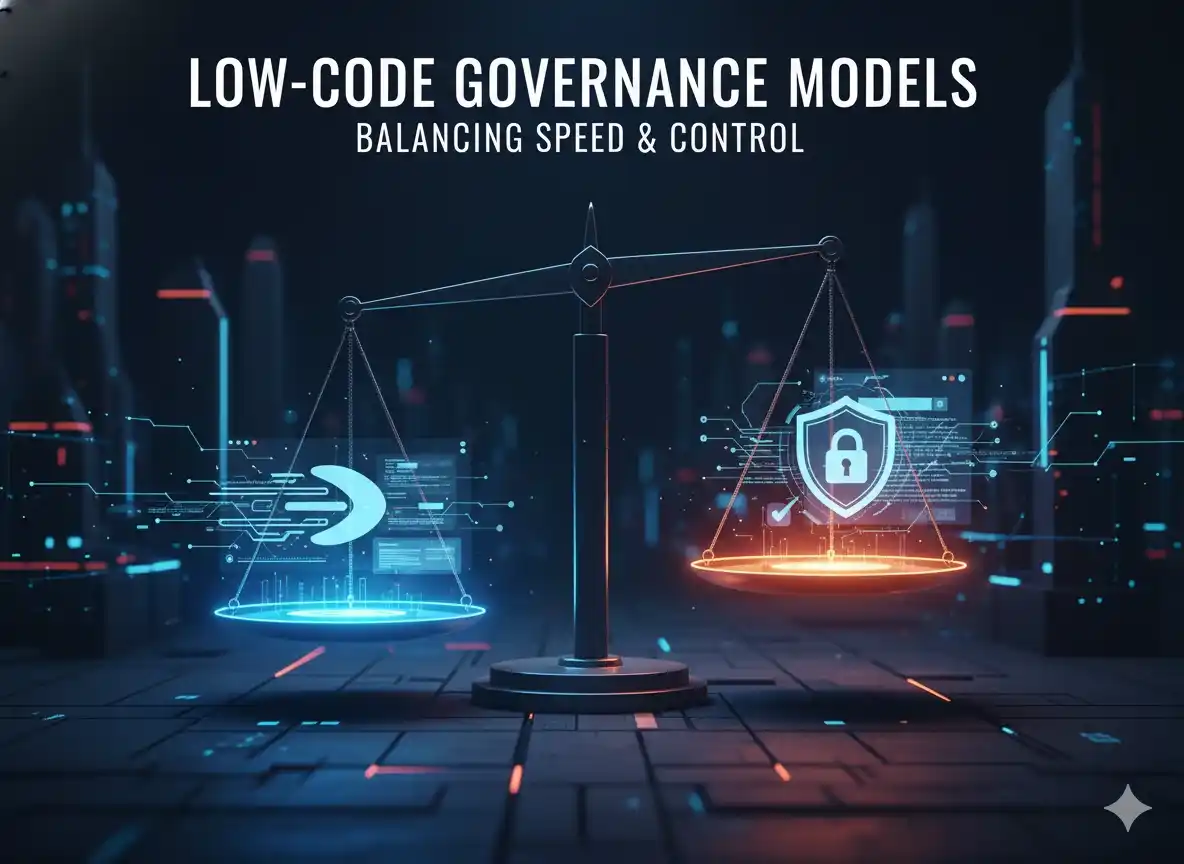
Low-code platforms have fundamentally changed how organizations build software. What once took months of development cycles can now be delivered in weeks—or even days. This speed has unlocked innovation across departments, empowered business teams, and reduced pressure on overburdened IT organizations.
However, as low-code adoption scales, a new challenge emerges: governance.
Without the right governance model, low-code initiatives can quickly drift into chaos—creating security risks, technical debt, and fragmented systems. On the other hand, excessive control can erase the very speed and flexibility that made low-code attractive in the first place.
The real challenge is not choosing between speed and control—but learning how to balance both.
This article explores low-code governance models, how organizations can apply them effectively, and how companies like We LowCode help businesses design governance frameworks that support innovation without sacrificing stability.
Why Governance Matters in Low-Code Development
Low-code platforms lower the barrier to application development. Business users, analysts, and operations teams can now participate directly in building solutions. This democratization is powerful—but it also introduces new risks.
Common governance challenges include:
Inconsistent application quality
Duplicate or overlapping tools
Security and compliance gaps
Poor scalability and maintainability
Lack of ownership and accountability
Governance is not about slowing teams down. It’s about creating guardrails that allow teams to move fast safely.
The Governance Paradox: Speed vs. Control
Every organization adopting low-code faces the same tension.
Too much freedom → rapid delivery, but long-term instability
Too much control → stability, but slow delivery and frustrated teams
Effective low-code governance resolves this paradox by separating decision rights, clarifying responsibilities, and defining standards without micromanagement.
The goal is not to control every application—but to control the system that produces applications.
Understanding Low-Code Governance Models
There is no one-size-fits-all governance model. The right approach depends on organizational size, industry, risk tolerance, and digital maturity. However, most successful low-code programs fall into one of the following models—or a hybrid of them.
1. Centralized Governance Model
In a centralized model, IT or a central digital team owns:
Platform access
Architecture standards
Security and compliance
Deployment and lifecycle management
When It Works Best
Highly regulated industries
Early stages of low-code adoption
Organizations with limited development maturity
Pros
Strong security and consistency
Clear ownership
Easier compliance management
Cons
Slower delivery
Limited business agility
Risk of IT becoming a bottleneck
Centralized governance prioritizes control, but often struggles to scale innovation across the organization.
2. Decentralized (Citizen Development) Model
In this model, business teams have greater autonomy to build and deploy applications independently.
When It Works Best
Smaller organizations
Non-critical internal tools
Teams with strong technical literacy
Pros
Maximum speed and innovation
High business ownership
Reduced IT dependency
Cons
Inconsistent quality
Security and data risks
Long-term maintenance challenges
This model is often attractive to companies looking to build internal tools with low code USA teams quickly—but without governance, it can create more problems than it solves.
3. Federated (Hybrid) Governance Model
The federated model is widely considered the most effective approach for modern organizations.
In this setup:
IT defines standards, guardrails, and platform governance
Business teams build applications within those boundaries
Shared ownership exists across the lifecycle
Key Characteristics
Centralized standards, decentralized execution
Clear role definitions
Reusable components and templates
Controlled deployment pipelines
This model balances speed and control by design—making it ideal for organizations scaling low-code across departments.
Core Components of an Effective Low-Code Governance Framework
Regardless of the model, strong governance depends on a few foundational elements.
1. Clear Role Definitions
Successful low-code programs define who does what.
Typical roles include:
Platform owner
Solution architect
Citizen developer
IT reviewer
Business product owner
Clarity prevents overlap, reduces friction, and ensures accountability.
2. Application Classification
Not all applications carry the same risk.
Governance should distinguish between:
Mission-critical systems
Departmental workflows
Experimental or prototype apps
This allows organizations to apply appropriate levels of control instead of blanket restrictions.
3. Standards and Reusable Assets
Governance works best when teams are enabled, not constrained.
Reusable elements such as:
UI templates
Integration patterns
Security modules
Data models
Allow teams to move faster within approved boundaries.
4. Security and Compliance by Design
Security cannot be optional in low-code environments.
Governance should address:
Access control
Data handling policies
Audit logging
Regulatory compliance
When security is embedded into the platform and process, teams don’t have to choose between speed and safety.
5. Lifecycle and Ownership Management
Every application needs:
A clear owner
Defined maintenance responsibility
Retirement or upgrade plans
This prevents “orphaned apps” and long-term technical debt.
Governance for Small Businesses vs. Enterprises
Governance is not only for large enterprises. Even small organizations benefit from lightweight frameworks—especially when growth is expected.
A low code agency for small business USA clients often focuses on:
Simple approval workflows
Basic security standards
Minimal but effective documentation
The key is right-sized governance—not enterprise-level bureaucracy.
As businesses scale, governance can mature alongside them.
Building Internal Tools Without Losing Control
One of the most common low-code use cases is internal tooling. Teams want to automate workflows, reduce manual tasks, and respond quickly to operational needs.
When organizations build internal tools with low code USA teams, governance should:
Encourage experimentation
Limit exposure to sensitive systems
Provide safe deployment paths
Internal tools are ideal candidates for federated governance—fast to build, but still aligned with IT standards.
The Role of Governance in Long-Term Scalability
The true test of low-code success is not how fast the first app is delivered—but how well the ecosystem scales over time.
Strong governance:
Reduces rework and duplication
Improves application quality
Enables cross-team collaboration
Protects platform investments
Without it, organizations risk recreating the same problems low-code was meant to solve.
How We LowCode Helps Organizations Govern Low-Code at Scale
At We LowCode, we see governance as an enabler—not a constraint.
Our approach focuses on:
Designing governance models aligned with business goals
Defining practical standards teams can actually follow
Supporting both speed and control through structure
Whether working with enterprises or acting as a low code agency for small business USA, our goal is the same: help organizations move fast without losing control.
Key Takeaways
Low-code governance is essential for sustainable success
Speed and control are not opposites—they are complements
Federated governance models offer the best balance
Governance should scale with organizational maturity
Internal tools and small teams still need structure—just the right amount
Low-code platforms unlock incredible potential. Governance ensures that potential turns into lasting value.
Conclusion
Low-code adoption is no longer a question of if, but how. Organizations that succeed are not the ones that move fastest—but the ones that move wisely.
By implementing the right governance model, businesses can empower teams, accelerate delivery, and maintain control over their digital landscape.
With a thoughtful approach and the right partner, low-code becomes more than a development tool—it becomes a strategic advantage.
At We LowCode, we believe the future belongs to organizations that balance speed with responsibility—and governance is the key to achieving both.
About the author

Ashok Kata
Ashok Kata is the Founder of We LowCode, a top low-code firm in Hampton, VA. With 14+ years in IT, he specializes in Mendix, OutSystems, Angular, and more. A certified Mendix Advanced Developer, he leads a skilled team delivering scalable, intelligent apps that drive rapid, cost-effective digital transformation.
Ashok Kata
Ashok Kata is the Founder of We LowCode, a top low-code firm in Hampton, VA. With 14+ years in IT, he specializes in Mendix, OutSystems, Angular, and more. A certified Mendix Advanced Developer, he leads a skilled team delivering scalable, intelligent apps that drive rapid, cost-effective digital transformation.
- admin
- admin

We help businesses accelerate digital transformation with expert Low-Code development services—delivering secure, scalable, and future-ready solutions.
Contact us
Location
- Hampton, VA 23662 United States of America
Phone
- +1(512)-779-6895
Email us
- contact@welowcode.com