- contact@welowcode.com
- Hampton, VA 23662

Monolith to Microservices: Where Low-Code Fits (and Where It Doesn’t)
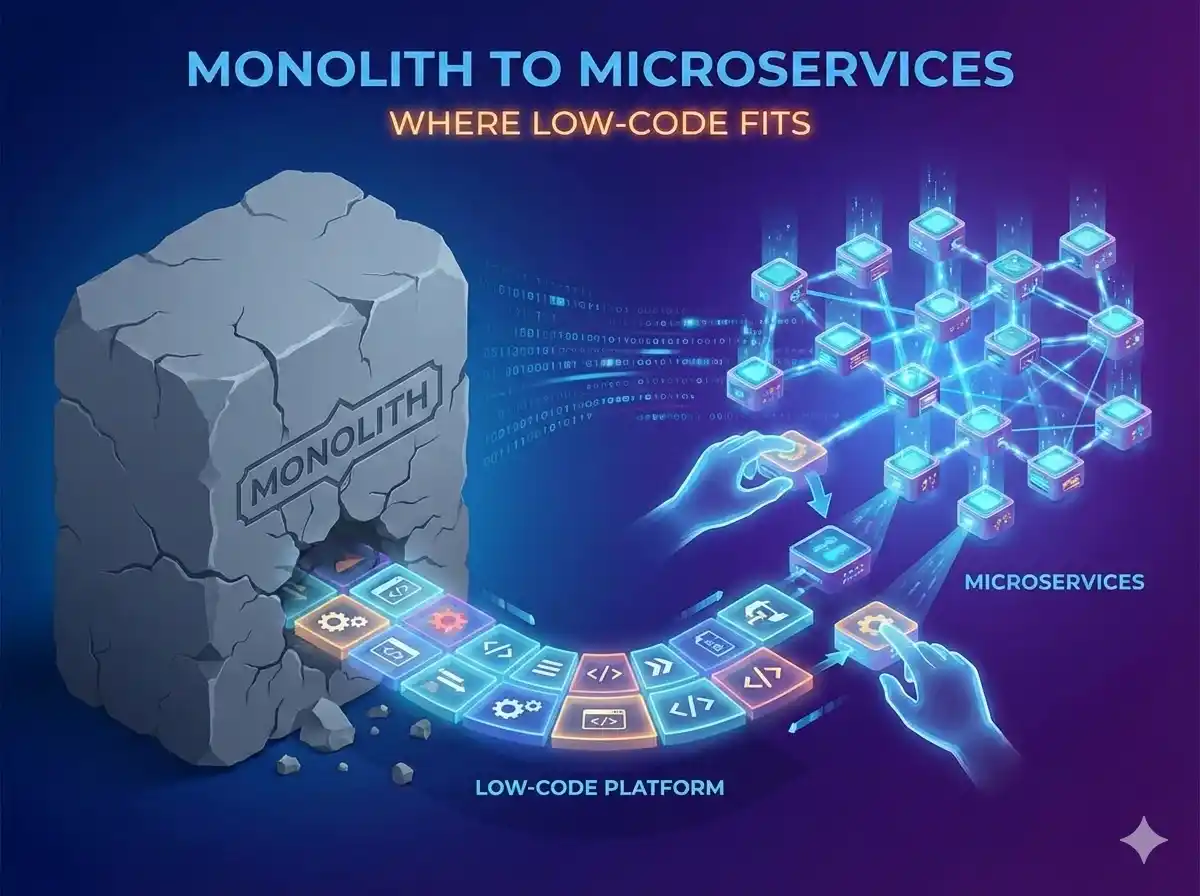
Modern software architecture is undergoing a fundamental shift. As organizations scale their digital platforms, many find that traditional monolithic applications—once stable and reliable—begin to slow innovation, complicate deployments, and limit agility. In response, microservices architectures have emerged as a powerful alternative, offering flexibility, scalability, and independent evolution of systems.
At the same time, low-code platforms are transforming how applications are built, enabling faster delivery and broader participation in development. This convergence raises an important question for technology leaders:
Where does low-code fit in a monolith-to-microservices journey—and where does it not?
This article explores that question with a balanced, real-world perspective, helping enterprises, startups, and small businesses understand how to use low-code effectively without misapplying it.
Understanding the Monolith vs. Microservices Debate
What Is a Monolithic Architecture?
A monolithic application is built as a single, tightly coupled unit. All business logic, data access, and user interfaces are deployed together.
Strengths of monoliths:
Simple to develop initially
Easier testing and deployment at small scale
Clear ownership in early stages
Limitations at scale:
Slower release cycles
High risk during deployments
Difficult to scale individual components
Tightly coupled dependencies
For many organizations, monoliths become a bottleneck as business complexity grows.
What Are Microservices?
Microservices break applications into smaller, independently deployable services. Each service focuses on a specific business capability and communicates through APIs.
Benefits of microservices:
Independent scaling and deployment
Faster innovation cycles
Better fault isolation
Technology flexibility
However, microservices also introduce operational complexity, including service orchestration, observability, and governance.
Why Organizations Move from Monolith to Microservices
The transition is rarely driven by technology trends alone. Common business drivers include:
Faster time-to-market requirements
Growing development teams
Need for independent scaling
Continuous delivery expectations
Modernization of legacy systems
For low code development for startups USA, this transition often happens earlier, as startups prioritize speed and scalability from day one. For enterprises and small businesses, the shift is more gradual and strategic.
Where Low-Code Fits in a Microservices Strategy
Low-code platforms are not a replacement for microservices—but they can play a strategic supporting role when used correctly.
1. Building Experience and Workflow Layers
Low-code excels at building:
User interfaces
Business workflows
Orchestration logic
Internal portals and dashboards
In a microservices ecosystem, low-code applications can sit on top of backend services, consuming APIs without owning core domain logic.
This approach allows teams to:
Deliver user-facing features quickly
Adapt workflows without redeploying core services
Reduce dependency on backend teams
This is a common pattern when organizations build internal tools with low code USA teams to support operations while core systems remain service-driven.
2. Accelerating Strangler-Fig Modernization
The “strangler-fig” pattern is a popular approach to monolith modernization, where parts of the system are gradually replaced rather than rewritten entirely.
Low-code fits well here by:
Replacing specific modules (e.g., approvals, reporting)
Creating new micro frontends
Integrating with existing monolith APIs
This incremental approach reduces risk and allows organizations to modernize at a sustainable pace.
3. Enabling Rapid Innovation at the Edge
Microservices architectures often expose stable APIs that power multiple consumers. Low-code can act as a rapid innovation layer on top of these APIs.
Use cases include:
Pilot features
Regional or department-specific apps
Proof-of-concept solutions
For a low code agency for small business USA, this model is especially valuable—clients can innovate quickly without overhauling core systems.
Where Low-Code Does NOT Fit Well
Understanding limitations is just as important as recognizing strengths.
1. Core Domain Microservices
Low-code is generally not ideal for building:
High-throughput core services
Latency-sensitive processing engines
Complex event-driven systems
These services often require:
Fine-grained performance tuning
Custom concurrency control
Advanced infrastructure patterns
Traditional code frameworks are better suited here.
2. Highly Specialized or Algorithmic Logic
If a service involves:
Advanced algorithms
Heavy data processing
Real-time analytics
Low-code abstraction can become a constraint rather than a benefit.
3. Platform-Level Infrastructure Services
Services responsible for:
Service discovery
API gateways
Message brokers
Observability tooling
Should remain outside low-code platforms and be handled by specialized infrastructure tools.
Low-Code as a Complement, Not a Replacement
The most successful organizations treat low-code as part of the architecture, not the architecture itself.
In modern systems:
Microservices handle core business capabilities
APIs expose reusable services
Low-code applications orchestrate, extend, and adapt
This separation of concerns ensures both speed and stability.
Implications for Startups, Small Businesses, and Enterprises
Startups
For low code development for startups USA, low-code can:
Accelerate MVP development
Validate ideas quickly
Delay premature microservices complexity
As startups scale, low-code apps can coexist with microservices rather than being replaced immediately.
Small Businesses
A low code agency for small business USA often focuses on:
Operational efficiency
Internal tooling
Customer portals
Microservices may be introduced selectively, while low-code handles the majority of application needs.
Enterprises
Enterprises benefit most from:
Federated architectures
Strong API governance
Clear boundaries between low-code and core services
Low-code becomes a force multiplier rather than a risk.
Governance Is the Deciding Factor
Without governance, low-code in a microservices environment can create:
Shadow integrations
Duplicate logic
Security gaps
With governance, it becomes:
A controlled innovation layer
A bridge between business and IT
A productivity accelerator
Successful organizations define:
Where low-code is allowed
What it can own
How it integrates with microservices
Key Architectural Patterns That Work
Backend-for-Frontend (BFF) with low-code UIs
API-first microservices consumed by low-code apps
Event-driven cores with low-code workflow layers
Strangler-fig modernization using low-code modules
These patterns balance autonomy, speed, and control.
Common Mistakes to Avoid
Rewriting an entire monolith in low-code
Treating low-code apps as disposable without ownership
Allowing direct database access to microservices
Ignoring observability and performance monitoring
Low-code requires architectural discipline, not shortcuts.
The Future: Hybrid Architectures Are the Norm
The future is not monolith or microservices or low-code. It is hybrid.
Organizations will continue to:
Decompose monoliths selectively
Build new services where needed
Use low-code to adapt quickly
Those who understand where each approach fits will move faster—with less risk.
Conclusion
The journey from monolith to microservices is not a binary decision—it’s a continuous evolution. Low-code plays a valuable role in that journey when used intentionally and strategically.
It fits best where speed, flexibility, and business alignment matter most—and less where raw performance and deep technical specialization are required.
Whether supporting low code development for startups USA, helping clients as a low code agency for small business USA, or enabling teams to build internal tools with low code USA, the key is balance.
When architecture decisions are driven by purpose rather than trends, low-code and microservices together can create systems that are not only scalable—but sustainable.

We help businesses accelerate digital transformation with expert Low-Code development services—delivering secure, scalable, and future-ready solutions.
Contact us
Location
- Hampton, VA 23662 United States of America
Phone
- +1(512)-779-6895
Email us
- contact@welowcode.com