- contact@welowcode.com
- Hampton, VA 23662

Observability in Mendix: Advanced Logging, Metrics, and Distributed Tracing for Enterprise Performance
As enterprises increasingly rely on low-code platforms to modernize their application landscape, visibility into application behavior has become a strategic necessity rather than a technical luxury. Mendix, as a leading enterprise low-code platform, enables rapid application development—but speed alone is not enough. To operate Mendix applications reliably at scale, organizations must adopt a mature observability strategy.
Observability in Mendix goes beyond basic monitoring. It provides deep insights into application health, performance bottlenecks, user behavior, and system dependencies. For enterprises undergoing digital modernization, advanced observability—through logging, metrics, and distributed tracing—is critical to ensuring resilience, scalability, and business continuity.
This article explores how observability applies to Mendix-based systems, how enterprises can integrate tools like Datadog, New Relic, and Elastic, and why observability is a foundational pillar of enterprise modernization and low-code strategy.
Why Observability Matters in Mendix-Based Enterprise Systems
Mendix applications often sit at the center of complex enterprise ecosystems. They integrate with ERPs, CRMs, data warehouses, identity providers, and third-party services. While low-code development Mendix simplifies application creation, it does not eliminate operational complexity.
Traditional monitoring answers basic questions:
Is the application up or down?
Are CPU and memory within limits?
Observability answers deeper, more strategic questions:
Why is a transaction slow for certain users?
Where is latency introduced across integrated systems?
Which business process is degrading under load?
How does a Mendix app behave under real-world usage?
For organizations investing in Mendix Development Services or broader low code enterprise solutions, observability becomes essential to sustaining performance as applications scale.
Observability vs Monitoring in Mendix
Monitoring and observability are often used interchangeably, but they serve different purposes.
Monitoring
Tracks predefined metrics
Alerts on known failure conditions
Reactive in nature
Observability
Explains why systems behave the way they do
Enables proactive diagnosis
Supports complex, distributed architectures
In enterprise Mendix environments, observability is particularly important because applications often evolve rapidly. New microflows, integrations, and services are added continuously, making static monitoring insufficient.
The Three Pillars of Observability in Mendix
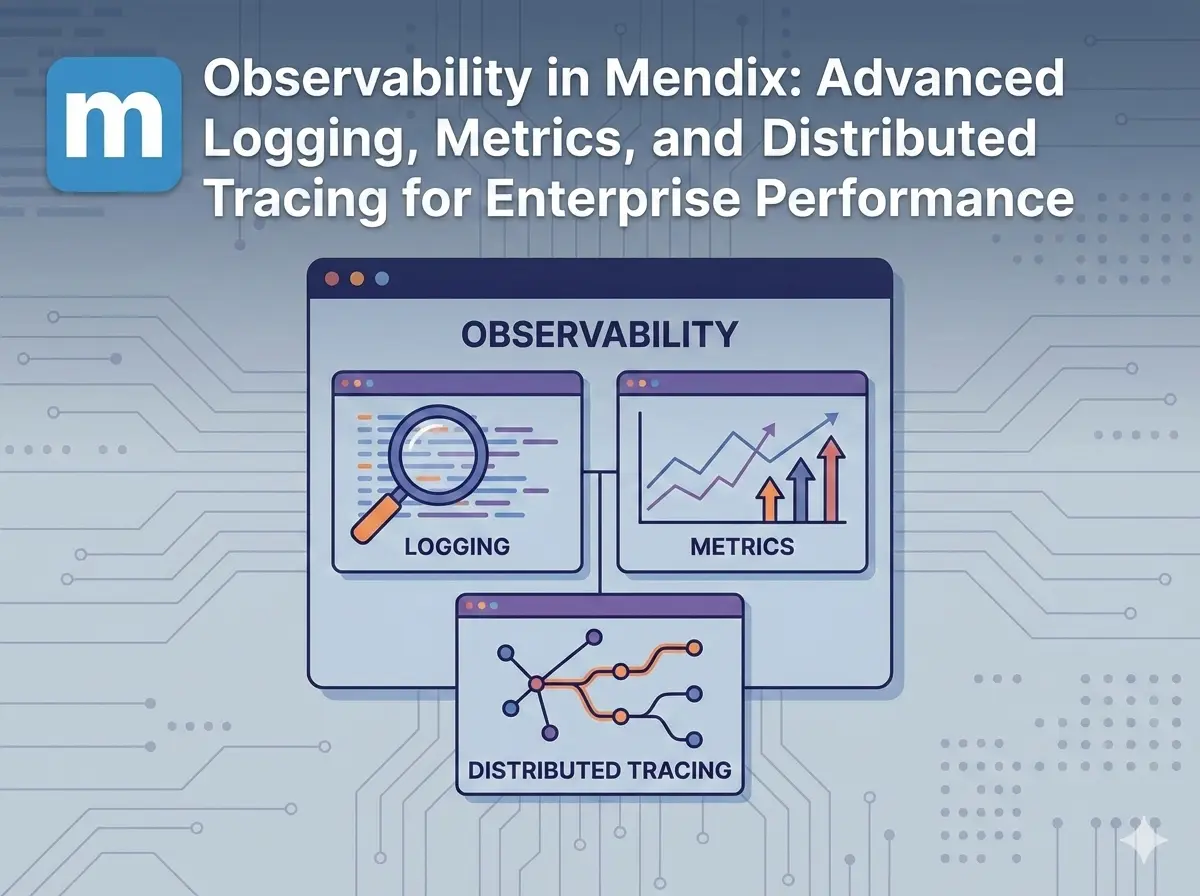
A complete observability strategy for Mendix applications is built on three core pillars:
Logging
Metrics
Distributed Tracing
Each pillar provides a different perspective on application behavior, and together they enable comprehensive system understanding.
Advanced Logging in Mendix Applications
Logging is the foundation of observability. Mendix provides built-in logging capabilities, but enterprise-grade observability requires structured, centralized, and searchable logs.
What to Log in Mendix
Effective logging in Mendix should capture:
Application errors and exceptions
Microflow execution details
Integration request and response payloads
Authentication and authorization events
Business process milestones
Rather than logging everything, a well-designed Mendix Development Solution focuses on meaningful, contextual logs that support diagnostics without creating noise.
Centralized Log Management
Enterprise Mendix deployments benefit from centralized logging platforms such as:
Elastic Stack (ELK)
Datadog Logs
New Relic Logs
Centralized logs allow teams to correlate Mendix application events with infrastructure, database, and integration-layer activity.
This capability is especially valuable for organizations working with a Mendix Consultant or Mendix consulting Services to modernize legacy systems and migrate to cloud-native architectures.
Metrics: Measuring What Matters in Mendix
Metrics provide quantitative insight into how Mendix applications perform over time. They enable teams to detect trends, identify capacity issues, and validate performance improvements.
Key Mendix Metrics to Track
For enterprise environments, meaningful metrics often include:
Request throughput and response times
Microflow execution duration
Error rates by module or service
Database query performance
JVM memory and garbage collection
Integration latency
Metrics should align with business impact, not just technical thresholds. This alignment is a core principle of effective Mendix consulting and low-code strategy.
Distributed Tracing in Mendix: Understanding End-to-End Flows
Distributed tracing is the most powerful—and often the most overlooked—pillar of observability.
In a typical enterprise setup, a single user action in a Mendix app may trigger:
A microflow
One or more REST or SOAP integrations
Database operations
External service calls
Distributed tracing follows a request across all these components, revealing where time is spent and where failures occur.
Why Distributed Tracing Is Critical for Mendix
Identifies latency across integrated systems
Simplifies root cause analysis
Improves incident response time
Supports performance optimization initiatives
For organizations building low code solutions for businesses that span multiple systems, distributed tracing transforms troubleshooting from guesswork into data-driven analysis.
Integrating Observability Tools with Mendix
Modern observability platforms integrate seamlessly with cloud-native applications, including Mendix deployments.
Datadog Integration with Mendix
Datadog provides unified monitoring across logs, metrics, and traces.
Key integration benefits:
JVM and container-level metrics
Application performance monitoring (APM)
Distributed tracing across services
Custom dashboards for Mendix KPIs
Datadog is often used in enterprise low code app development services where real-time visibility and alerting are critical.
New Relic for Mendix Performance Monitoring
New Relic focuses on application-level insights and user experience monitoring.
Key capabilities include:
End-user response time analysis
Transaction tracing
Error analytics
Infrastructure correlation
For enterprises modernizing customer-facing Mendix applications, New Relic helps link technical performance to user experience and business outcomes.
Elastic Stack (ELK) for Mendix Observability
Elastic offers powerful log analytics and search capabilities.
Key use cases:
Centralized Mendix log ingestion
Full-text search and correlation
Custom visualizations
Security and audit log analysis
Elastic is commonly adopted in regulated industries where log retention, auditing, and compliance are essential components of low code consulting USA engagements.
Observability as Part of Enterprise Modernization Strategy
Observability should not be treated as an afterthought or a tooling decision. It must be embedded into the overall enterprise modernization strategy.
Organizations investing in custom low code app development often focus on speed—but without observability, rapid development can lead to operational blind spots.
A mature observability strategy:
Supports continuous delivery
Enables safe scaling
Reduces downtime and MTTR
Improves collaboration between business and IT
This strategic approach is a core focus of advanced Mendix consulting Services and enterprise low-code initiatives.
Governance, Security, and Compliance Considerations
Enterprise observability must align with governance and compliance requirements.
Key considerations include:
Data masking in logs
Role-based access to observability platforms
Retention policies for logs and metrics
Auditability of system changes
These aspects are particularly important for financial services, healthcare, and regulated industries adopting low code enterprise solutions.
Best Practices for Implementing Observability in Mendix
To maximize value, enterprises should follow proven best practices:
Design observability early, not post-deployment
Standardize logging and metrics across applications
Correlate technical metrics with business KPIs
Use distributed tracing selectively for high-impact flows
Continuously refine dashboards and alerts
These practices are often guided by experienced Mendix Consultant teams working alongside enterprise stakeholders.
The Future of Observability in Low-Code Platforms
As low-code platforms evolve, observability will become increasingly intelligent. AI-driven anomaly detection, predictive performance analysis, and automated root cause identification are already emerging.
For organizations leveraging Mendix Development Services and broader low code consulting services, observability will be a key differentiator between scalable success and operational risk.
Conclusion
Observability in Mendix is no longer optional for enterprise environments. Advanced logging, metrics, and distributed tracing provide the visibility required to operate modern, interconnected systems with confidence.
By integrating tools like Datadog, New Relic, and Elastic, organizations can transform Mendix applications from black boxes into transparent, measurable, and continuously optimized systems.
For enterprises pursuing modernization through Mendix Development Solution strategies or investing in low code solutions for businesses, observability is not just a technical capability—it is a strategic foundation for sustainable digital transformation.
About the author

Ashok Kata
Ashok Kata is the Founder of We LowCode, a top low-code firm in Hampton, VA. With 14+ years in IT, he specializes in Mendix, OutSystems, Angular, and more. A certified Mendix Advanced Developer, he leads a skilled team delivering scalable, intelligent apps that drive rapid, cost-effective digital transformation.
Ashok Kata
Ashok Kata is the Founder of We LowCode, a top low-code firm in Hampton, VA. With 14+ years in IT, he specializes in Mendix, OutSystems, Angular, and more. A certified Mendix Advanced Developer, he leads a skilled team delivering scalable, intelligent apps that drive rapid, cost-effective digital transformation.
- Ashok K
- Ashok K

We help businesses accelerate digital transformation with expert Low-Code development services—delivering secure, scalable, and future-ready solutions.
Contact us
Location
- Hampton, VA 23662 United States of America
Phone
- +1(512)-779-6895
Email us
- contact@welowcode.com