- contact@welowcode.com
- Hampton, VA 23662

Real-Time AI Pipelines in Mendix: Building Intelligent Systems That Act, Not Just Analyze
Learn how to build real-time AI pipelines in Mendix to enable instant insights, automated decisions, and scalable intelligent systems.
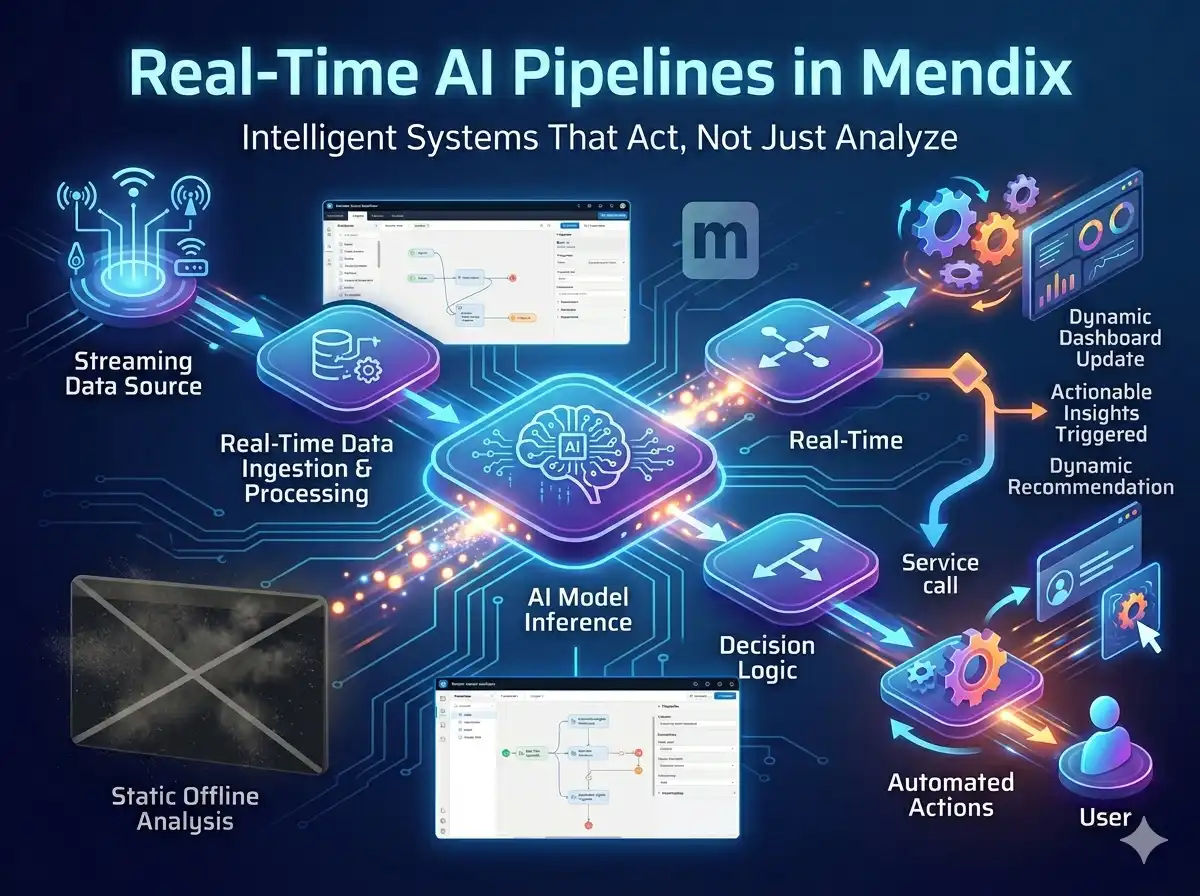
The Gap Between Insight and Action
Most enterprises have invested heavily in data and AI.
They have:
- Dashboards with real-time metrics
- Predictive models generating insights
- Data pipelines processing large volumes of information
Yet, a critical gap remains.
Insights are generated — but action is delayed.
In many organizations, decisions still depend on:
- Manual interpretation
- Batch processing cycles
- Disconnected systems
This delay reduces the value of AI.
Real-time AI pipelines change this equation by enabling systems to:
- Process data continuously
- Generate insights instantly
- Trigger actions automatically
When implemented correctly, they transform AI from a reporting tool into an operational engine.
Why Traditional AI Pipelines Fail to Deliver Real-Time Value
Most AI pipelines are designed for analysis, not execution.
They operate in stages:
- Data collection
- Data processing
- Model inference
- Output generation
While this works for reporting, it introduces latency when applied to operational systems.
Key limitations include:
Batch-Oriented Processing
Data is processed in intervals, which delays decision-making.
Disconnected Systems
AI outputs are often stored separately from business applications, requiring manual intervention.
Limited Integration with Workflows
Insights are not embedded into operational processes, reducing their practical impact.
High Complexity in Deployment
Traditional pipelines require coordination across multiple tools and teams, slowing down iteration.
The Shift: From Analytical Pipelines to Operational Pipelines
Real-time AI pipelines are fundamentally different.
They are designed to:
- Process streaming data
- Generate insights instantly
- Execute actions within applications
This requires tight integration between:
- Data systems
- AI models
- Application workflows
Mendix enables this integration by providing a unified environment where these components can work together seamlessly.
What Defines a Real-Time AI Pipeline in Mendix
A real-time AI pipeline is not just about speed.
It is about creating a continuous loop where data, intelligence, and action are interconnected.
Key characteristics include:
Continuous Data Flow
Instead of batch updates, systems process:
- Streaming events
- Real-time inputs
- Dynamic user interactions
Embedded Intelligence
AI models are integrated directly into application logic, allowing:
- Instant predictions
- Context-aware recommendations
- Automated decision-making
Immediate Execution
Insights are not stored — they are acted upon.
This includes:
- Triggering workflows
- Updating systems
- Notifying users
Feedback Loops
Every action generates new data, which is used to:
- Improve models
- Refine decisions
- Optimize outcomes
Architecture of Real-Time AI Pipelines in Mendix
To build effective real-time systems, enterprises must adopt a layered architecture.
1. Data Ingestion Layer
This layer captures:
- User interactions
- System events
- External data streams
It ensures that data enters the system in real time.
2. Processing and Streaming Layer
Data is processed continuously using:
- Event-driven architectures
- Streaming frameworks
This layer prepares data for immediate use.
3. Intelligence Layer
AI models analyze incoming data to:
- Generate predictions
- Identify patterns
- Recommend actions
4. Application Layer
Mendix integrates AI outputs into workflows, enabling:
- Automated decisions
- Dynamic UI updates
- Context-aware interactions
5. Execution Layer
Actions are executed instantly, including:
- Updating records
- Triggering notifications
- Initiating processes
Practical Use Cases: Where Real-Time AI Pipelines Deliver Value
Real-time pipelines are most effective in environments where speed directly impacts outcomes.
1. Fraud Detection and Prevention
Systems can:
- Analyze transactions instantly
- Identify anomalies
- Block suspicious activity in real time
2. Intelligent Customer Engagement
Applications can:
- Personalize interactions dynamically
- Recommend products or actions
- Respond instantly to user behavior
3. Operational Optimization
Enterprises can:
- Monitor processes continuously
- Identify inefficiencies
- Adjust operations in real time
4. Predictive Maintenance
Systems can:
- Analyze equipment data
- Predict failures
- Trigger maintenance before breakdowns occur
Why Mendix Is a Strong Fit for Real-Time AI Systems
Building real-time pipelines traditionally requires complex integration across multiple systems.
Mendix simplifies this by:
- Providing a model-driven development environment
- Enabling seamless integration with APIs and data sources
- Supporting rapid iteration and deployment
Through structured Mendix Consulting, enterprises can design systems where:
- AI models are tightly integrated with workflows
- Data flows continuously across components
- Decisions are executed without delay
This reduces complexity while increasing speed and scalability.
Bridging the Gap Between AI Capability and Business Impact
Many organizations struggle to convert AI investments into measurable outcomes.
The primary issue is not the quality of models, but the lack of integration with business processes.
Real-time AI pipelines address this by:
- Embedding intelligence into workflows
- Enabling automated decision-making
- Reducing dependency on manual intervention
With the right approach to AI App Development Services, enterprises can:
- Align AI capabilities with operational goals
- Deliver immediate value from data
- Create systems that continuously improve
Managing Challenges in Real-Time AI Implementation
While the benefits are significant, real-time systems introduce new challenges.
Data Consistency
Ensuring accurate data across streaming systems is critical.
System Scalability
Pipelines must handle:
- High data volumes
- Increasing user interactions
- Growing complexity
Latency Management
Even small delays can impact performance in real-time systems.
Governance and Control
Enterprises must maintain:
- Data privacy
- Compliance
- Model transparency
Strategic Framework for Implementation
To successfully implement real-time AI pipelines, organizations should follow a structured approach:
1. Identify High-Impact Use Cases
Focus on areas where:
- Speed directly affects outcomes
- Decisions are time-sensitive
2. Design for Integration
Ensure that:
- Data, AI, and applications are connected
- Systems can communicate seamlessly.
3. Build Incrementally
Start with:
- Specific workflows
- Targeted use cases
Then expand based on results.
4. Establish Feedback Mechanisms
Continuously:
- Monitor system performance
- Improve models
- Optimize workflows.
When Real-Time AI Pipelines Become a Competitive Advantage
Real-time AI delivers the most value when:
- Decision speed impacts revenue or risk
- Systems require continuous optimization
- User experience depends on responsiveness
- Data is generated at high frequency
In such environments, delayed decisions are not just inefficient – they are costly.
Conclusion: From Reactive Systems to Intelligent Execution
The next phase of enterprise transformation is not about collecting more data or building more models.
It is about enabling systems to:
- Act on data instantly
- Make decisions autonomously
- Adapt continuously
Real-time AI pipelines make this possible.
Mendix provides the foundation to build these systems without the complexity traditionally associated with real-time architectures.
Organizations that adopt this approach move beyond analysis and into execution — where true value is created.
At We LowCode, real-time AI pipelines are designed as integrated, scalable systems that connect data, intelligence, and action, enabling enterprises to operate with speed, precision, and confidence.
About the author

Ashok Kata
Ashok Kata is the Founder of We LowCode, a top low-code firm in Hampton, VA. With 14+ years in IT, he specializes in Mendix, OutSystems, Angular, and more. A certified Mendix Advanced Developer, he leads a skilled team delivering scalable, intelligent apps that drive rapid, cost-effective digital transformation.
Ashok Kata
Ashok Kata is the Founder of We LowCode, a top low-code firm in Hampton, VA. With 14+ years in IT, he specializes in Mendix, OutSystems, Angular, and more. A certified Mendix Advanced Developer, he leads a skilled team delivering scalable, intelligent apps that drive rapid, cost-effective digital transformation.
- Ashok K
- Ashok K

We help businesses accelerate digital transformation with expert Low-Code development services—delivering secure, scalable, and future-ready solutions.
Contact us
Location
- Hampton, VA 23662 United States of America
Phone
- +1(512)-779-6895
Email us
- contact@welowcode.com