- contact@welowcode.com
- Hampton, VA 23662

Replacing Legacy Systems with Low-Code: A Realistic Roadmap for Enterprises
Discover a realistic low-code roadmap with Mendix consulting, AI integration, and faster enterprise transformation.
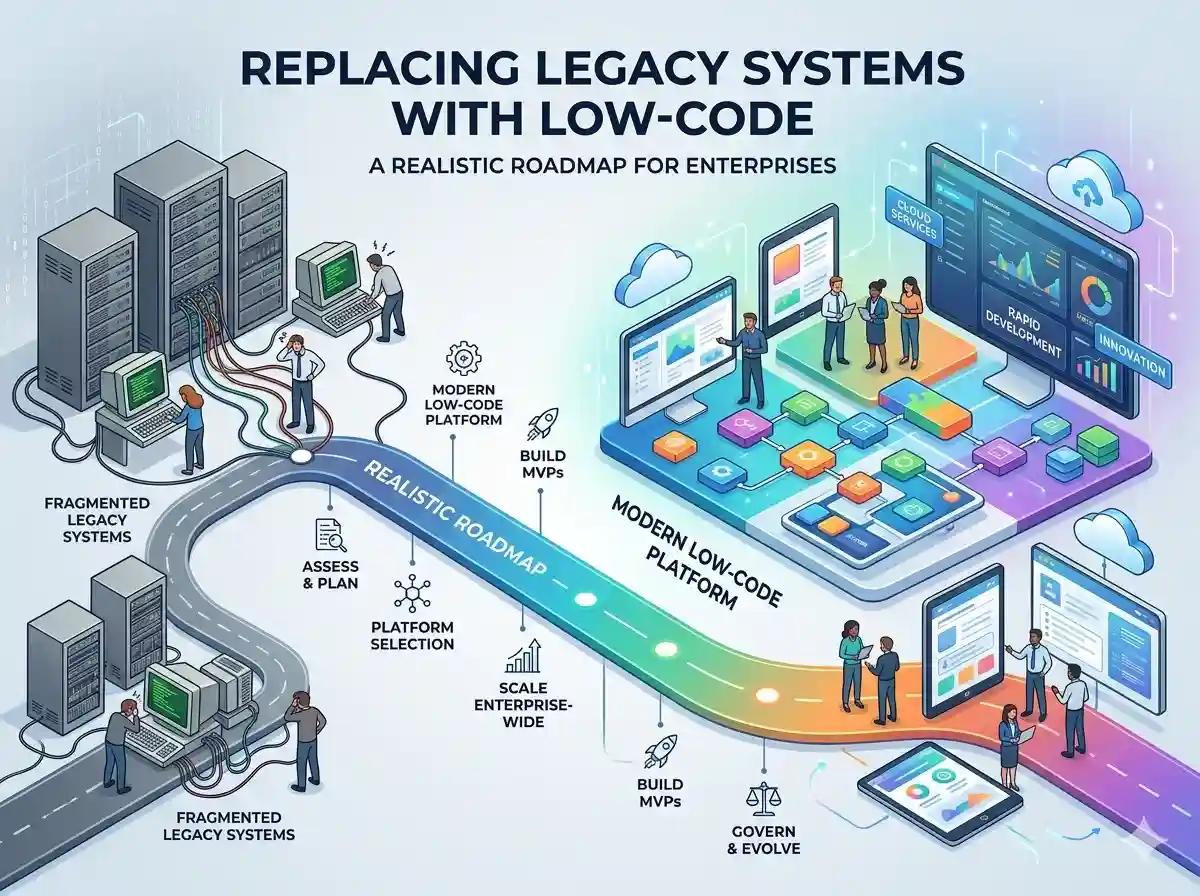
Introduction: The Legacy System Challenge
Enterprises today are not limited by a lack of technology — they are constrained by systems built for a different era.
Legacy infrastructure often results in:
Rising maintenance costs
Limited scalability
Slow response to business changes
Despite these challenges, replacing legacy systems is often delayed due to perceived risks around cost, disruption, and complexity.
This is where the role of a strategic low code consultant becomes critical.
Modernization is no longer about replacing everything at once. It is about building a structured, low-risk path toward transformation.
Why Legacy Replacement Fails in Most Enterprises
Many modernization initiatives fail not because of technology limitations, but because of poor execution strategy.
Common challenges include:
Attempting full system rewrites with long timelines
Misalignment between business and IT priorities
Underestimating the complexity of data migration
Over-engineering solutions without clear ROI
These issues lead to delayed outcomes, increased costs, and operational disruptions.
Replacing legacy systems requires a phased, strategic approach rather than a one-time transformation effort.
The Low-Code Advantage in Legacy Modernization
Low-code platforms such as Mendix enable enterprises to modernize systems incrementally.
Instead of large-scale replacement, organizations can:
Develop modular applications
Modernize high-impact areas first
Integrate with existing systems
With the support of an experienced Mendix consulting partner like We LowCode, enterprises can achieve faster development cycles and reduce transformation risks.
Low-code allows systems to evolve while maintaining business continuity.
A Realistic Roadmap to Replace Legacy Systems
A successful modernization strategy requires a structured roadmap that balances speed with stability.
Assessment and Prioritization
The first step is identifying systems that create the highest business impact. This includes:
Applications that slow down operations
Systems with high maintenance costs
Areas where modernization can deliver immediate value
Prioritization ensures that transformation efforts generate measurable ROI early in the process.
Modular Replacement Strategy
Instead of replacing entire systems, enterprises should adopt a modular approach:
Break systems into smaller functional components
Replace critical modules first
Retain legacy components where necessary
This approach reduces risk and accelerates time-to-value.
Integration Before Elimination
Legacy systems do not need to be removed immediately.
Low-code platforms allow:
Seamless integration with existing infrastructure
Gradual transition of workloads
Continuous operation without disruption
This ensures stability throughout the transformation process.
Rapid Application Development
Low-code enables faster development and iteration cycles.
Enterprises can:
Build and deploy applications quickly
Continuously improve based on user feedback
Adapt to changing business requirements
An experienced low code consultant ensures that development aligns with long-term business goals.
Data Migration and Optimization
Data migration is one of the most critical aspects of modernization.
A phased approach helps:
Ensure data accuracy and consistency
Minimize risk during transition
Improve overall data architecture
Adding Intelligence Through AI
Modern enterprise systems must go beyond functionality and deliver intelligence.
By partnering with an experienced ai app development company like We LowCode, organizations can:
Automate operational workflows
Enable predictive analytics
Improve decision-making through real-time insights
This transforms legacy replacement into a broader digital transformation initiative.
Business Impact of Low-Code Modernization
Enterprises adopting low-code for legacy system replacement typically experience:
Faster development timelines
Reduced overall development and maintenance costs
Improved operational efficiency
Greater flexibility in adapting to market demands
More importantly, organizations shift from reactive system management to proactive innovation.
When Should Enterprises Start?
Delaying modernization increases both cost and risk.
Enterprises should consider immediate action if they are experiencing:
Increasing system maintenance expenses
Delays in application development
Difficulty integrating modern technologies
The key question is not whether to modernize, but how to do it in a controlled and strategic manner.
Conclusion: Turning Legacy Systems into Strategic Assets
Legacy systems were designed for stability, not agility.
Modern enterprises require systems that are scalable, adaptable, and intelligent.
Low-code provides a pathway to achieve this without the risks associated with traditional system replacement approaches.
We LowCode helps enterprises transition from outdated infrastructure to scalable digital ecosystems designed for long-term growth.
For enterprises evaluating legacy system modernization, a phased low-code approach offers a practical balance between speed, cost, and risk.
Making the right move at the right time can define long-term competitive advantage.
About the author

Ashok Kata
Ashok Kata is the Founder of We LowCode, a top low-code firm in Hampton, VA. With 14+ years in IT, he specializes in Mendix, OutSystems, Angular, and more. A certified Mendix Advanced Developer, he leads a skilled team delivering scalable, intelligent apps that drive rapid, cost-effective digital transformation.
Ashok Kata
Ashok Kata is the Founder of We LowCode, a top low-code firm in Hampton, VA. With 14+ years in IT, he specializes in Mendix, OutSystems, Angular, and more. A certified Mendix Advanced Developer, he leads a skilled team delivering scalable, intelligent apps that drive rapid, cost-effective digital transformation.
- Ashok K
- Ashok K
We help businesses accelerate digital transformation with expert Low-Code development services—delivering secure, scalable, and future-ready solutions.
Contact us
Location
- Hampton, VA 23662 United States of America
Phone
- +1(512)-779-6895
Email us
- contact@welowcode.com